Daiso Beauty Is Actually Good Now — Here’s Why
From Amorepacific to LG H&H, major Korean beauty companies are building products for Daiso. Here’s why ₩5,000 K-beauty suddenly makes a lot more sense.
By A Drop of Seoul Editorial ·
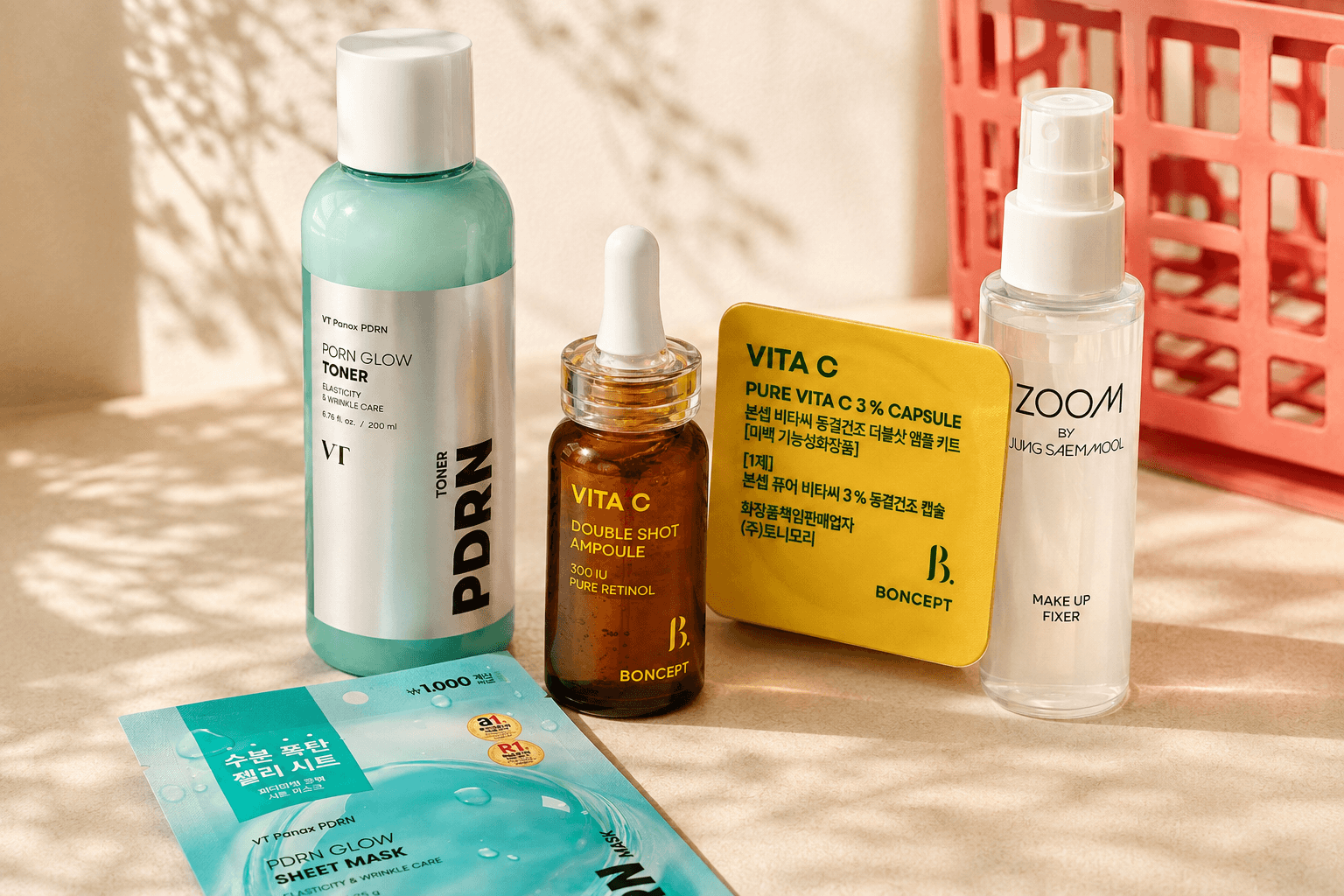
A few years ago, buying beauty products at Daiso meant something slightly different. You went there for cotton pads, puffs, cotton swabs, maybe a few basic beauty tools. There was skincare and makeup on the shelves, but Daiso wasn’t necessarily somewhere you went for beauty. That has changed surprisingly fast. If you’re new to the store, start with our local guide to Daiso Korea.
Today, you can find VT PDRN toner and sheet masks, makeup carrying the JUNGSAEMMOOL name, and Daiso-focused brands and lines backed by some of Korea’s biggest beauty companies, including Amorepacific and LG H&H. And much of it costs between ₩1,000 and ₩5,000. For anyone seeing the beauty aisle for the first time, the obvious question is:
Can a ₩5,000 skincare product actually be any good?
But there’s a more interesting question behind it.
Why are some of Korea’s biggest beauty companies making ₩5,000 products in the first place?
Follow that question, and Daiso Beauty starts to look less like a curiosity — and more like a clue to where K-beauty is going next.
Daiso Beauty got big, fast
The shift isn’t just anecdotal. At the end of 2023, Daiso reportedly carried about 26 beauty brands and 250 products. By the end of 2024, that had more than doubled to roughly 60 brands and 500 products. Reports put the assortment at around 150 brands and 1,420 products by the end of 2025, then about 170 brands and 1,900 products by April 2026. Sales moved with it. Daiso’s cosmetics sales grew by about 144% year over year in 2024.
At that point, it becomes difficult to describe beauty as a small side category inside Daiso. It has become a shopping destination of its own. But the more interesting change is who is showing up there.
The K-beauty name you know — and the Daiso line you might not
If you’re new to Daiso Beauty, one of the most interesting things to look at isn’t just the product name. It’s the company behind it. Names you may have seen at Olive Young or on international K-beauty sites can show up at Daiso in a very different form.
| Brand you may know | What you’ll see at Daiso | Example | Price |
|---|---|---|---|
| Mamonde | MIMO by MAMONDE | Rosy-Hyalon Moisture Ampoule 50ml | ₩5,000 |
| CNP Laboratory | CNP bye od-td | Hydra Calming Cream 50ml | ₩5,000 |
| JUNGSAEMMOOL Beauty | ZOOM by JUNGSAEMMOOL | Makeup Fixer 50ml | ₩5,000 |
| B.READY | Prep by B.READY | Hicaffeine Cypress Water Skin Toner 200ml | ₩5,000 |
| Etude | Play 101 by Etude | Coloring Gloss 01 Dewy Peach | ₩3,000 |
Amorepacific, for example, introduced MIMO by MAMONDE as a second brand connected to Mamonde for the Daiso channel. A 50ml Rosy-Hyalon Moisture Ampoule sells for ₩5,000. If you know CNP Laboratory, you may come across CNP bye od-td at Daiso, including a 50ml Hydra Calming Cream for ₩5,000. And if JUNGSAEMMOOL Beauty is already on your radar, Daiso has ZOOM by JUNGSAEMMOOL, where products such as the 50ml Makeup Fixer sit at the same ₩5,000 ceiling.
The important thing is not to read these as “the Olive Young product, only cheaper.” A familiar brand name or parent company doesn’t necessarily mean the Daiso product is the same formula in a smaller bottle. Companies can create separate brands, lines, sizes, formats, formulas or positioning specifically for this price point and channel. So the more useful question isn’t:
“How much cheaper is this than the regular product?”
It’s:
“What did this K-beauty company choose to make when it had to fit inside a ₩5,000 price ceiling?”
ADoS TIP
Don’t assume a familiar K-beauty name at Daiso means you’ve found a cheaper version — or a dupe — of something you already know. Check the exact product name, size and format first. A familiar name is a useful clue, but it doesn’t mean you’re looking at the same product.
So how can skincare cost ₩5,000?
This is usually the next question. When a typical K-beauty product might cost ₩20,000 or ₩30,000, how does a toner, cream or ampoule end up on a Daiso shelf for ₩3,000 to ₩5,000? One of the most visible differences is size and configuration.
Products may come in smaller quantities than their counterparts in conventional beauty channels. Packaging can be simpler. In other cases, the product itself is developed specifically around Daiso’s price structure. That’s why comparing only the number on the price tag can be misleading. A ₩5,000 purchase price is undeniably low. But that does not automatically mean the price per milliliter is dramatically lower.
ADoS TIP
When you spot a familiar beauty company at Daiso, look at the size as well as the price. If you’re comparing a regular line with a Daiso line, checking ₩ / ml can tell you much more than the sticker price alone. It’s also worth distinguishing between the company responsible for selling a product and the company that actually manufactures it. A familiar brand or responsible seller does not necessarily mean that company physically manufactured the formula.
Smaller isn’t necessarily worse — especially when you’re traveling
For travelers, this model can actually make a lot of sense. Maybe you’re curious about PDRN, retinol or a Korean brand you’ve never tried before, but not curious enough to commit to a full-size bottle. At ₩3,000 or ₩5,000, that decision becomes much easier.
If you don’t love it, the cost of being wrong is small. And smaller products are easier to fit into a suitcase. The same logic works for Korean shoppers. Instead of carefully choosing one ₩20,000 or ₩30,000 product, you can experiment with a ₩3,000 lip product and a ₩5,000 ampoule without turning either purchase into much of a decision.
For teenagers and younger shoppers who treat beauty as something to browse and play with, that difference matters.
“For this price, why not try it?”
That may be one of Daiso Beauty’s most powerful propositions.
Daiso isn’t only selling cosmetics. It’s selling a first try.
The model is interesting from the brand side, too. Convincing a new customer to spend ₩30,000 on a product they’ve never used is very different from getting them to pick up something for ₩5,000. Daiso dramatically lowers that first barrier.
That makes the channel useful for more than simply selling inexpensive cosmetics. It can become an entry point into a brand, ingredient or product format. Someone curious about PDRN can start with a ₩1,000 sheet mask. A traveler who has heard of JUNGSAEMMOOL but never bought anything from the brand can encounter a ₩5,000 ZOOM product.
Someone curious about vitamin C or retinol can experiment without committing to an entire routine. And if they like what they try, they may start looking at the wider brand next. Seen this way, it becomes easier to understand why established K-beauty companies might find Daiso interesting.
Does a big beauty name automatically make it good?
No. After buying and trying a fairly wide range of Daiso Beauty products ourselves, our first impression was actually pretty simple:
Most of them were fine.
Not life-changing. Not products we would recommend simply because they were cheap. But also not the kind of products that made us wonder how anyone could use them. And that may be exactly the point. At ₩1,000 to ₩5,000, choosing one product doesn’t have to become a major decision.
You can try it because you’re curious. If you like it, buy it again. If you don’t, move on.
If you end up loving something, great. If you don’t, you probably spent less than the price of a coffee.
There was, however, one category that stood out.
Sheet masks felt different
Among the products we tried, sheet masks were one of the easiest categories to appreciate for the price. That isn’t particularly surprising. Sheet masks are a mature category in Korea. Korean beauty manufacturers have spent years competing on the basics: sheet quality, fit, essence texture and hydration.
So when we tried the VT PDRN Glow Sheet Mask, our reaction wasn’t really:
This is good for ₩1,000.
It was closer to:
This is a genuinely decent sheet mask that happens to cost ₩1,000.
That distinction matters.
ADoS verdictDaiso Beauty is best understood as low-risk discovery, not miracle skincare.
When we look at a Daiso beauty product, we start with three questions: Who is behind it? What are the actual size and format of the Daiso version? And at this price, is there a good reason to try it?
A famous beauty company can make a product more interesting. It doesn’t automatically make it worth buying.
Wait — is Daiso actually competing with Olive Young now?
A few years ago, that would have sounded like a strange question. Daiso was where you bought household basics. Olive Young was where you bought beauty. Now both can be part of the same K-beauty shopping route.
As Daiso’s ₩1,000–₩5,000 beauty assortment grows, it’s reasonable to wonder whether you really need to visit Olive Young at all. We think you probably do. The two stores aren’t simply competing to sell the same products at different prices. They serve different ways of discovering K-beauty.
Daiso is for discovery. Olive Young is for selection.
And that difference matters more than it might seem.
What makes Daiso Beauty interesting isn’t simply that cosmetics have become cheaper. It’s that the cost of experimenting with K-beauty has become incredibly small. A ₩1,000 sheet mask. A ₩3,000 lip product. A ₩5,000 ampoule.
Instead of researching a brand, reading dozens of reviews and committing to one full-size product, you can discover something on a Daiso shelf, try it, and decide afterward whether you care enough to explore further. So perhaps the best way to approach Daiso Beauty isn’t to walk in expecting to find your next holy grail. It’s to find something that makes you a little curious — and try it without overthinking it.
That may be the most interesting thing Daiso is changing about K-beauty shopping.
More on Daiso
We Tried Daiso Beauty: What’s Actually Worth Buying?
We put Daiso beauty products to the test and sort them into BUY / TRY / SKIP.
Daiso vs Olive Young — Where Should You Buy K-Beauty?
If you’re going to both, what should you buy where?
A Drop of Seoul looks beyond what’s trending to find what’s actually worth discovering.
My Seoul Drop
Going to Daiso?
Before crossing Seoul for a famous flagship, see what’s already around you.
Find Daiso near you → My Seoul Drop