Daiso Korea: A Local’s Guide to Shopping Like a Korean
From ₩1,000 K-beauty finds and tiny Korean souvenirs to the everyday things you suddenly need while traveling, here’s how to shop Daiso Korea like a local.
By A Drop of Seoul Editorial ·
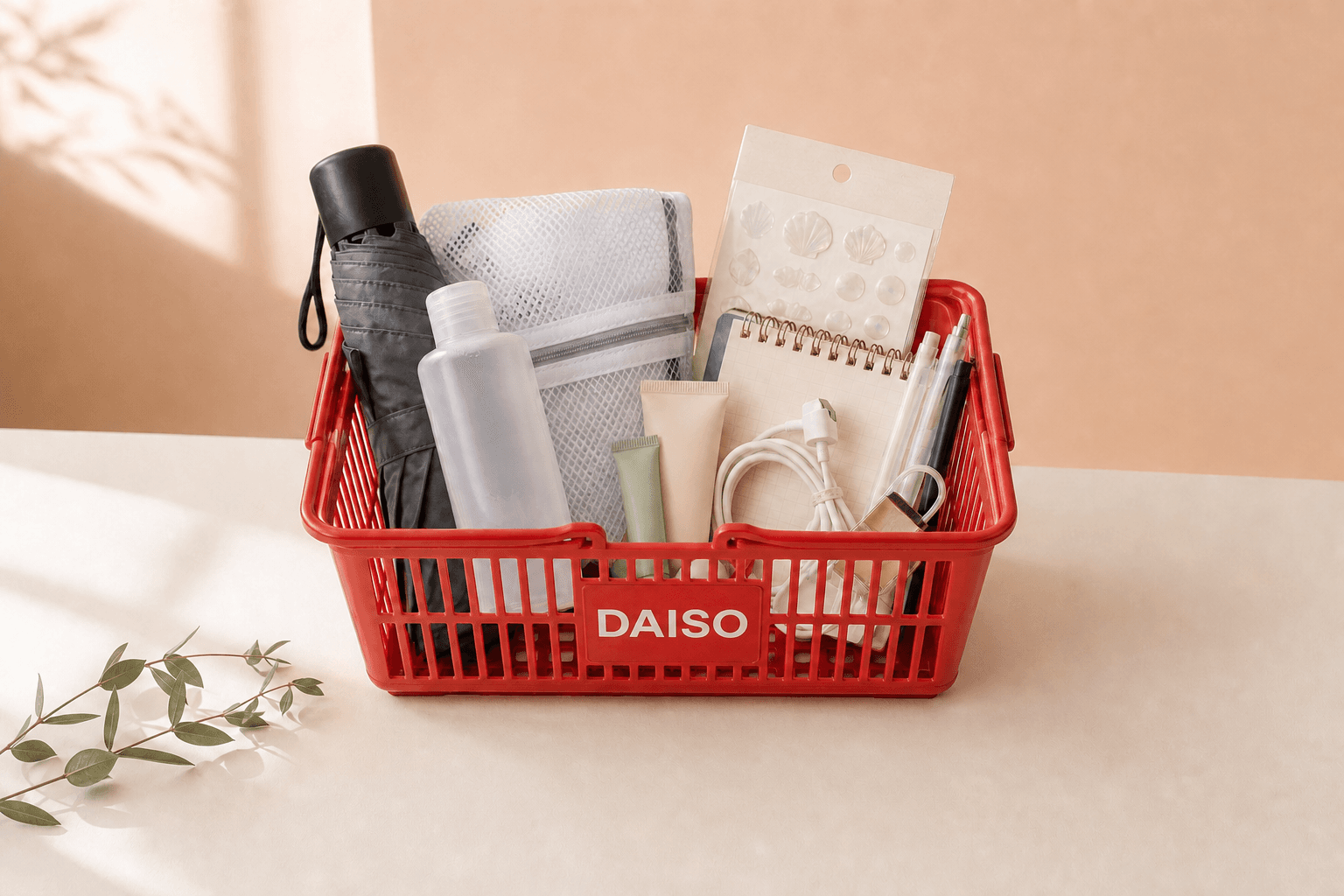
Spend a few days in Seoul and you’ll start noticing the same red sign everywhere: Daiso. Walk into one of the larger stores in Myeongdong and the scene gets even more interesting. One traveler is scrolling through saved TikToks at the beauty shelves; another is filling a basket with Korean souvenirs. Beside them, a local grabs mirror-cleaning wipes or a storage container and heads straight to checkout.
They’re all shopping at the same Daiso, but they’re not necessarily using it in the same way. For travelers, Daiso has become a Seoul shopping destination. For Koreans, it has traditionally been something more ordinary: the place you check when you think, “Daiso probably has this.”
That is starting to change. Over the past few years, the beauty section has expanded rapidly, with skincare and makeup mostly priced between ₩1,000 and ₩5,000. Major Korean beauty companies now develop products specifically for Daiso, and supplements have arrived too. Teenagers browse inexpensive lip products for fun; adults can try something new for ₩5,000 without making a serious financial commitment.
Calling Daiso simply “Korea’s dollar store” misses the point. It remains an incredibly practical everyday store, but increasingly it is also a place for low-cost discovery.
First, how cheap is Daiso Korea?
Price is usually the first surprise. You’ll see the same numbers again and again: ₩1,000 / ₩2,000 / ₩3,000 / ₩5,000. There are ₩500 beauty products, ₩1,000 makeup tools and full 200ml bottles of toner for ₩5,000. That makes filling a basket dangerously easy.
But cheap and worth buying are not the same thing. Ten ₩1,000 items are still ten things you have to take home. When choosing Daiso finds, we use one simple rule: cheap isn’t enough; it has to be worth the suitcase space.
What do Koreans actually use Daiso for?
Look at what Koreans actually buy and Daiso’s original role becomes much clearer. In Daiso Mall’s first-half 2026 sales data, some standout everyday bestsellers weren’t viral beauty products. They were facial tissues, mirror-cleaning wipes and wipes for removing grease from induction cooktops—not exactly TikTok material, and that’s the point.
You need to organize a drawer. There’s nowhere to hang something in the bathroom. You need a cable, or you forgot a travel bottle. For these small everyday problems, many Koreans instinctively think, “Maybe Daiso has it.” It’s where you go to solve a small problem without spending much money.
And that makes Daiso surprisingly useful for travelers
If you only visit Daiso for beauty products and souvenirs, you may miss one of its most useful functions. Imagine staying in Seoul for a week: it suddenly rains, you forgot a charging cable, you need a laundry net, the hotel slippers are uncomfortable, or there aren’t enough hangers. None of these things will appear on a glamorous Seoul shopping list, but they happen when you travel.
In Korea, you can often solve several of these problems in one bright, organized store at predictable, low prices. That makes Daiso more than a shopping destination for visitors; it becomes a small piece of everyday infrastructure. The longer you stay in Seoul, the more useful that becomes.
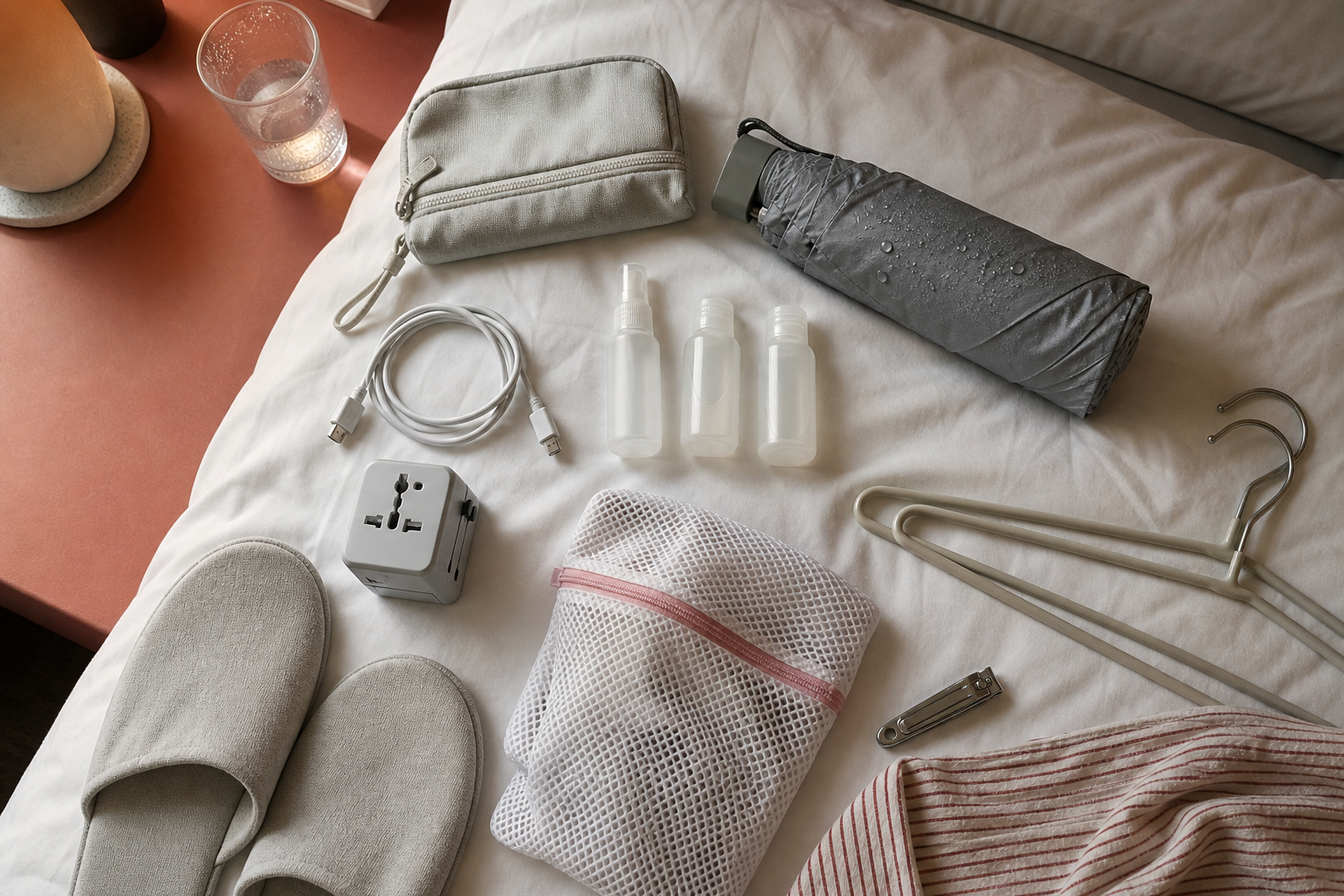
The unglamorous purchases can be the ones that save a trip. Original editorial image by A Drop of Seoul.
But Koreans are starting to go to Daiso just to browse
This is where the newer Daiso story begins.
Traditionally, you went to Daiso because you needed something. Now, more people also go simply to see what’s new, and beauty is at the center of that shift. Daiso’s beauty business has grown rapidly, with far more brands and products appearing on its shelves—including names connected to Amorepacific, LG H&H, Aekyung, Etude, VT and JUNGSAEMMOOL.
There is an important distinction: finding a familiar beauty name at Daiso doesn’t necessarily mean you’re getting the brand’s regular product for dramatically less. Companies often develop separate brands, lines, sizes, formulations or product configurations specifically for Daiso’s price structure. The more interesting question is why major Korean beauty companies are making ₩5,000 cosmetics at all.
Wait, is Daiso becoming a competitor to Olive Young?
A few years ago, that would have sounded like a strange question. Daiso sold household goods; Olive Young sold beauty. Now the two increasingly appear in the same K-beauty conversation.
For teenagers and younger shoppers in particular, the appeal is easy to understand. Instead of committing to one ₩20,000 or ₩30,000 product, you can pick up a ₩3,000 lip product, a ₩5,000 toner and a ₩1,000 sheet mask. If something doesn’t work out, the cost of failure is small.
That’s why Daiso Beauty’s advantage isn’t simply “the same thing, only cheaper.” We see the stores as serving different purposes: Daiso is for discovery; Olive Young is for selection. At Daiso, you can experiment. At Olive Young, you get a much broader range and can shop more deliberately. If K-beauty is part of your Seoul itinerary, visit both.
So what Daiso beauty products are actually worth buying?
This is where things get complicated: there are simply too many products. Going viral doesn’t automatically make something good, and a major beauty company’s involvement doesn’t automatically make it worth buying. Meanwhile, a product that barely appears on international social media may be selling extremely well among Korean shoppers.
Rather than rely on a single source, we compared Daiso Mall sales signals with Korean user reviews and reactions from international shoppers. That led us to familiar names like VT’s PDRN line, but it also surfaced products such as Mamicare’s Sea Grape Skin Pack, which caught our attention through Korean sales data before international hype.
Then there are products like the ₩500 Egg Capsule Pack. We wouldn’t call it serious skincare, but it’s tiny, fun and inexpensive enough to bring home as a small gift. The useful question isn’t “Is everyone talking about it?” It’s “Is it actually worth buying?”
TikTok told you to buy it. Should you?
Search for Daiso before a trip to Seoul and you’ll quickly encounter the same genre of video: Daiso Korea Must Buys. Things You NEED From Korean Daiso. Don’t Leave Korea Without These. They’re fun—we watch them too—but something that is fun to film isn’t always worth carrying home.
When something goes viral, ask a few different questions. Would you want it if TikTok hadn’t shown it to you? Is it actually cheaper? Is there a reason to buy it specifically in Korea? Will you use it? And finally: is it worth the suitcase space?
Wait, Daiso Korea sells supplements too?
It does. You’ll find vitamins, probiotics, omega-3 and Korean health functional foods targeting concerns such as blood sugar management or body fat. Since Daiso began selling health supplements in 2025, the number of participating companies and products has grown quickly. Products are now connected to familiar Korean pharmaceutical and health companies such as Chong Kun Dang, Daewoong, Dongkook, Yuhan and Dong Wha.
In typical Daiso fashion, the price tags might say ₩1,000, ₩2,000 or ₩5,000. But this is one category where you shouldn’t look at the sticker price alone. Many products come in small packs designed for a limited number of days, so compare price per day, number of servings and amount of the key ingredient rather than total purchase price. Korean health functional foods are not the same as over-the-counter medicine.
Is Daiso good for Korean souvenirs?
Yes—but not for everything. If you want one beautiful Korean craft object to keep for years, Daiso would not be our first stop. Try a museum shop, a well-curated traditional design store or somewhere in Insadong instead.
Daiso becomes more interesting when you need small gifts for ten coworkers, want something Korean without buying another generic tourist magnet, need it to be lightweight and don’t want to spend a fortune. Think mother-of-pearl-inspired stickers, Hojakdo luggage tags, Korean stationery, tiny soban tables or soju glasses.
A souvenir doesn’t necessarily need to look traditional either. A handful of tiny ₩500 K-beauty products can make surprisingly fun gifts: small, playful and easy to share.
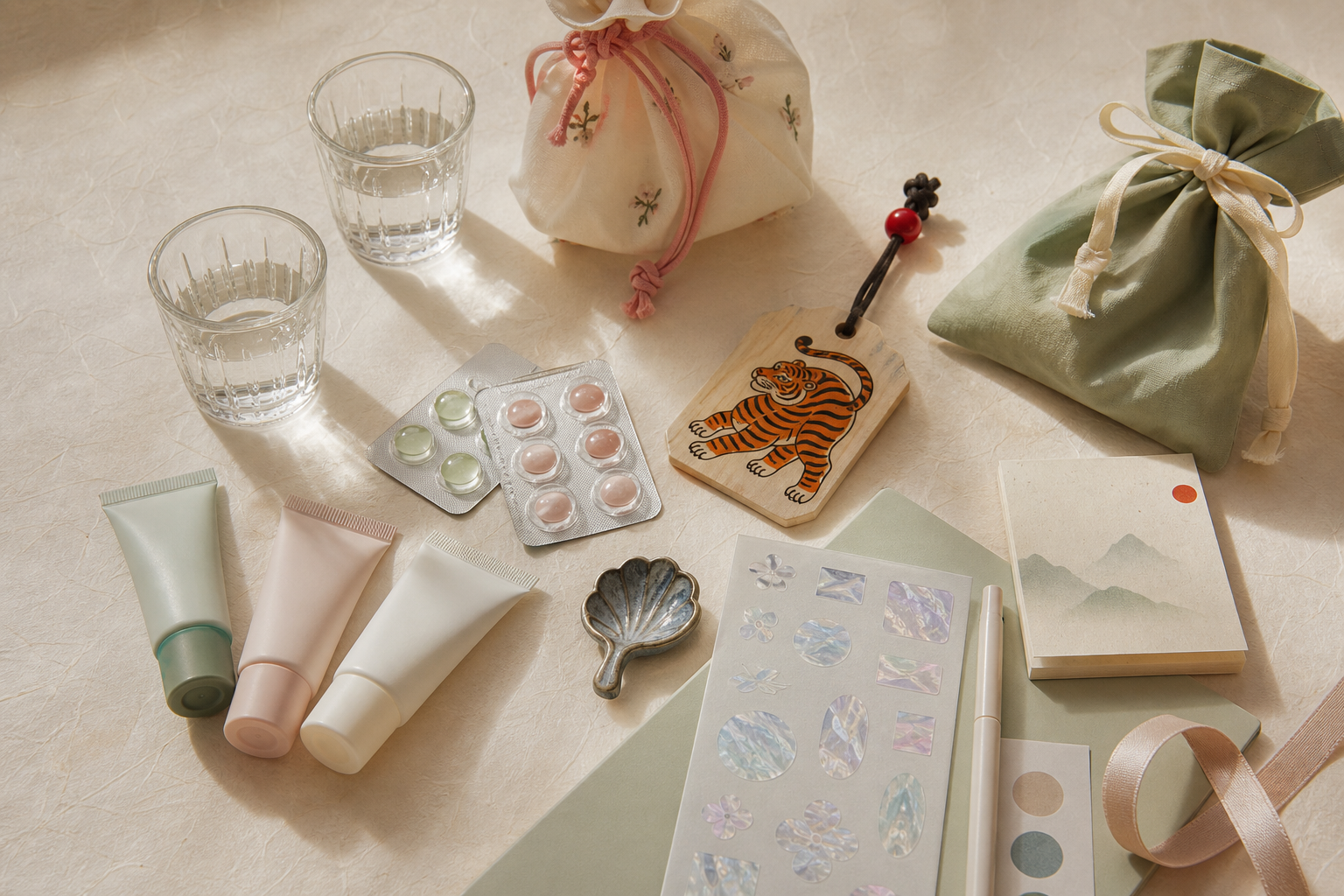
The sweet spot: small, useful or fun, and light enough to share. Original editorial image by A Drop of Seoul.
So, what should you actually buy at Daiso Korea?
You don’t need to memorize a list of 50 must-buys before walking in. It’s easier to think in three groups.
1. Something useful
Something you genuinely need during the trip: an umbrella, travel bottle, pouch, charging cable or laundry net.
2. Something fun
Something you probably wouldn’t have bought otherwise but can afford to discover while you’re in Korea—perhaps a ₩5,000 K-beauty product or a strange seasonal item.
3. Something to bring home
Something light enough to pack and useful or fun enough to keep—or give away. Korean stationery, a tiny beauty product or a practical little souvenir is enough.
Do you need to visit the biggest Daiso in Seoul?
Not necessarily. Large stores in places like Myeongdong can be fun because you can browse many categories in one place. If visiting Daiso is part of the experience you want, go for it. But if you simply need a travel item or basic beauty product, there’s usually no reason to cross Seoul for a famous branch. Store size and inventory vary.
Our rule is simple:
Need something? → Go to the nearest Daiso.
Want the Daiso experience? → Go to a large one.
We wouldn’t spend an hour traveling between stores to hunt down one viral ₩3,000 product. Once you spend an hour of your trip chasing it, it isn’t really a ₩3,000 purchase anymore.
If it’s your first time at Daiso Korea, remember this
Don’t think of Daiso only as Korea’s dollar store. Don’t stop at the beauty floor, assume a familiar brand name means it’s the exact same product sold elsewhere, or buy something simply because it went viral. And you definitely don’t need to bring everything home as a souvenir.
Shopping Daiso a little more like a local is simple:
Look there when you need something.
Try something when it looks fun.
Take it home only when it’s worth keeping.
Daiso may not be Seoul’s most glamorous shopping experience, but it can be a surprisingly good window into everyday life here. It’s where small daily problems get solved for a few thousand won—and increasingly, where people discover new beauty products and trends for a few thousand won too.
Maybe the best way to understand Daiso Korea is this:
Come for what you need.
Stay for what you discover.
My Seoul Drop
Going to Daiso?
Before crossing Seoul for a famous flagship, see what’s already around you.
Find Daiso near you → My Seoul Drop