Where to Discover Korean Fragrance in Seoul
A country that barely wore perfume ten years ago now exports it. Here's what it smells like.
By A Drop of Seoul Editorial ·
Ten years ago, wearing noticeable perfume in Seoul would have marked you out. Scent was something you got from fabric softener and a hand cream, and anything stronger felt faintly like imposing on people.
Then it changed, quickly, and it changed in a specific direction. Korea did not develop a taste for big French florals. It developed something more like an interior-design approach to smell — scent as atmosphere rather than statement, the way a room has a temperature.
That instinct is now an export industry.
Quick answer
Nonfiction for the clean-but-warm signature that defines the whole category. Tamburins for the object as much as the scent. Granhand for gifts. Born to Stand Out if you want something loud.
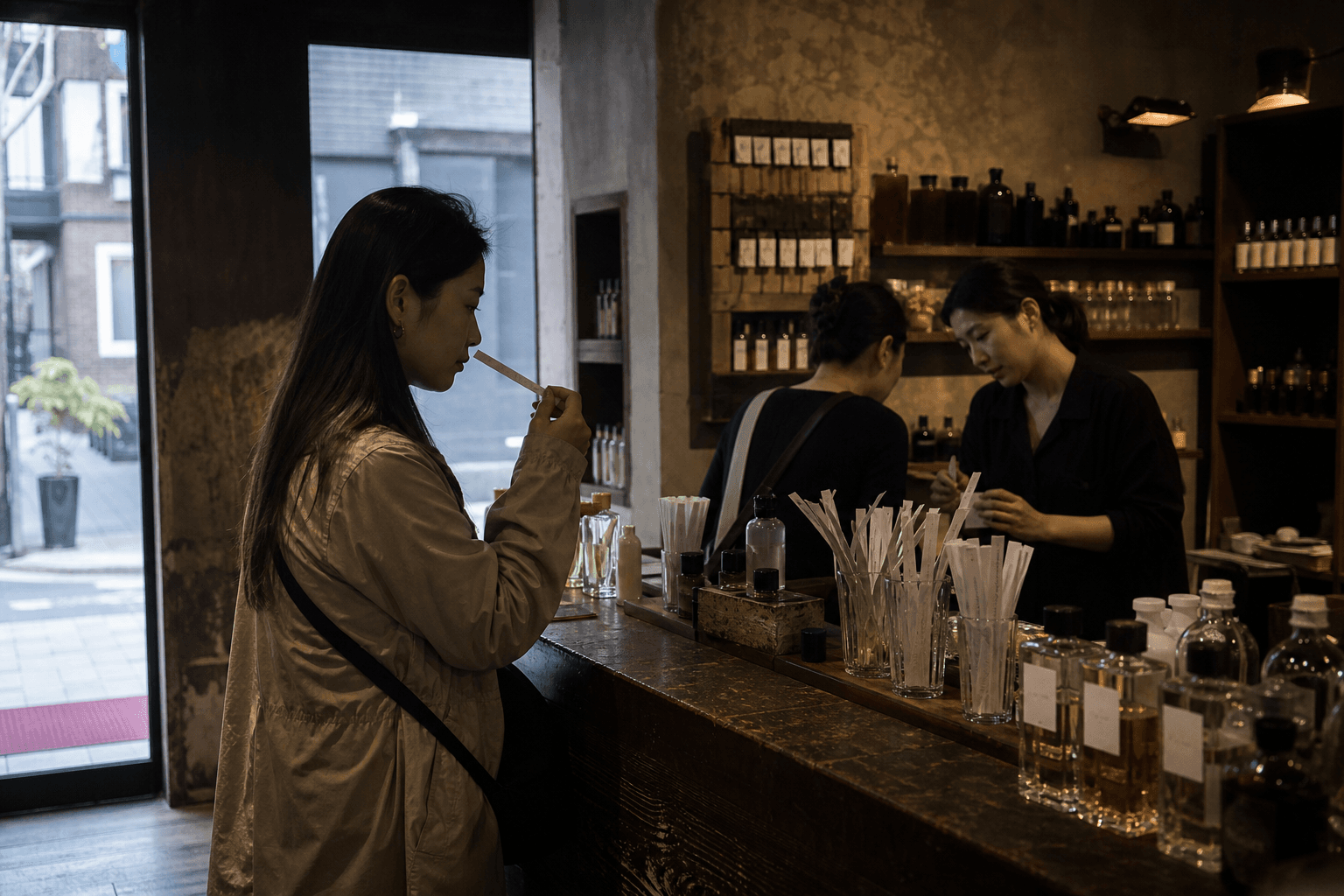
Smell them in Seongsu, where the two most important flagships are a five-minute walk apart. Then, if you have three hours, blend your own bottle — that's the part of this you can't do at home.
How fast this actually happened
Two numbers make the point better than any trend piece.
Nonfiction, launched in 2019, went from about ₩5.5 billion in revenue in 2020 to roughly ₩47.9 billion last year. Nearly nine times, in four years.
Tamburins went from about ₩34.8 billion to ₩164.6 billion over the same stretch — more than four times.
Both are now pushing into the US and China. This is not a niche hobby category anymore; it's the next thing Korean beauty is exporting after skincare, and it happened while most of the world was still talking about sheet masks.
The brands, and what they're actually for
Nonfiction (논픽션)
The signature of the category. Nonfiction's scents are clean and refined, but the thing that distinguishes them is a deliberate warmth — the brand's own framing has been about the feeling of arriving somewhere familiar, like a grandmother's house. That's a very Korean brief: not seductive, not statement-making, but comforting in a way that reads as expensive.
Where: the Seongsu showroom is a pared-back, gallery-like space with open counters built for unhurried testing rather than a quick grab. It's the right room for the brand.
Start with: the hand washes and hand creams, which are how most Koreans meet this brand and are a much lower-commitment entry than a bottle.
Tamburins (탐버린즈)
The one where the object matters as much as the scent. The hand cream with a chain attached did more for this brand than any note pyramid ever could, and having Jennie as the face of it did the rest.
That's not a criticism. Tamburins understands something real about how fragrance is bought here — as a designed thing you carry, not just a liquid you wear.
Where: the Seongsu flagship is a raw-concrete, cave-like room with rotating art installations, on one of the neighborhood's original converted-warehouse streets. The architecture is genuinely a reason to go.
Fair warning: it's busy, and it's one of the most photographed interiors in Seongsu. Go early.
Granhand (그랑핸드)
The gift one, and we mean that as praise. Granhand's range sits at a friendlier price and scale than the two above — diffusers, hand creams, small bottles — which makes it the brand we most often actually buy for other people.
Its largest flagship opened earlier this year in Mapo, with the shop on the ground floor and a café above it. That combination tells you the register the brand is going for.
Born to Stand Out (본투스탠드아웃)
The loud one. Where most Korean niche fragrance is restrained, this one is deliberately direct and a little bold. If you've smelled your way through the clean-and-warm end of this category and found it too polite, start here.
The honest caveat about Korean fragrance
If your reference points are French or Middle Eastern niche perfumery, calibrate your expectations.
Korean fragrance skews clean, musky, soapy, and quiet. It's brilliant at a specific thing — smelling like a well-kept room, or like someone who just showered in a very nice bathroom — and largely uninterested in the heavy, complex, hours-of-development style that dominates niche perfumery elsewhere.
Whether that's a limitation or exactly what you've been looking for depends entirely on you. A lot of people who find traditional perfume overwhelming discover they can wear Korean fragrance daily. A lot of people who love oud find it thin. Both reactions are correct.
Sillage is generally modest. That's a design choice, in a culture where scenting the space around other people is treated as slightly rude.
Blend your own — the part worth booking
This is the genuinely un-exportable experience, and it's the thing we'd actually recommend over buying a bottle.
Greedy Scent Bukchon is the atmospheric choice — blending from thirty-plus notes inside the hanok village, holding a 4.9 rating across 28 reviews. Reviewers keep describing the result the same way: the memory of the trip, bottled. There's a Yeonnam branch if you're on that side of the river.
Lumiere Perfume Seongsu is the one to book if you want a person with you. The teaching is genuinely one-on-one, and enough guests come back for the upgrade package that it says something. There's a Hongdae branch too.
.NOTE is the opposite instinct — tablet-guided and self-paced, with nobody at your shoulder. If being taught makes you self-conscious, this is your version. Branches in Hongdae and Gangnam as well.
Practical notes: budget two to three hours, book ahead, and don't do it on a day you're wearing perfume. Your nose needs to arrive clean.
What we'd skip
Buying a full bottle on day one. Fragrance changes with climate, and Seoul's humidity is doing something to what you're smelling. Get samples, wear them for a week, then decide.
Testing more than four things in a session. Your nose stops working. This is not willpower; it's physiology. Coffee beans don't reset it either, whatever the shop assistant says — stepping outside for ten minutes actually does.
Assuming the flagship is where to buy. The flagships are for experiencing. Chicor carries Tamburins and Nonfiction alongside Hermès fragrance, which is a better room for comparing across price tiers.
Duty free, for Korean niche. It's fine for the big French houses and largely useless for the brands in this article.
Read next
Doing the Seongsu walk anyway? The beauty-and-bites route. Looking for the whole shopping picture? Where we'd shop for Korean beauty beyond Olive Young. Thinking about what to carry home? The Seoul souvenirs we'd actually bring back.
FAQ
What are the best Korean perfume brands?
Nonfiction and Tamburins are the two that define the category and have driven its export growth — Nonfiction from roughly ₩5.5 billion in 2020 revenue to about ₩47.9 billion last year, Tamburins from ₩34.8 billion to ₩164.6 billion. Granhand is the accessible gift-scale option; Born to Stand Out is the bolder one.
What does Korean perfume smell like?
Predominantly clean, musky, soapy, and restrained — scent treated as atmosphere rather than statement. Projection is deliberately modest. If you find conventional perfume overwhelming, this category often works; if you love heavy orientals, it can read as thin.
Where can I make my own perfume in Seoul?
Greedy Scent in Bukchon offers blending from thirty-plus notes in the hanok village; Lumiere in Seongsu and Hongdae provides one-on-one guidance; .NOTE runs tablet-guided, self-paced private classes in Seongsu, Hongdae, and Gangnam. Allow two to three hours and book ahead.
Where should I buy Korean fragrance in Seoul?
Test at the Seongsu flagships, then buy wherever is convenient — Chicor carries the major Korean niche brands alongside international ones, which makes comparison easier. Duty free is not useful for this category.
Is Korean fragrance expensive?
The bottles sit in the accessible-niche range rather than at luxury-house prices, and the hand creams and body products most brands lead with are a much cheaper entry point. Granhand in particular is priced for gifting.