What’s the Spiciest Korean Food? A Seoul Ordering Guide
Why Shin Ramyun can be a useful reference point, how Buldak went global, and what to order if your spice tolerance has other plans.
By A Drop of Seoul Editorial Team ·
Seoul-based reporting and human editorial review · How we work
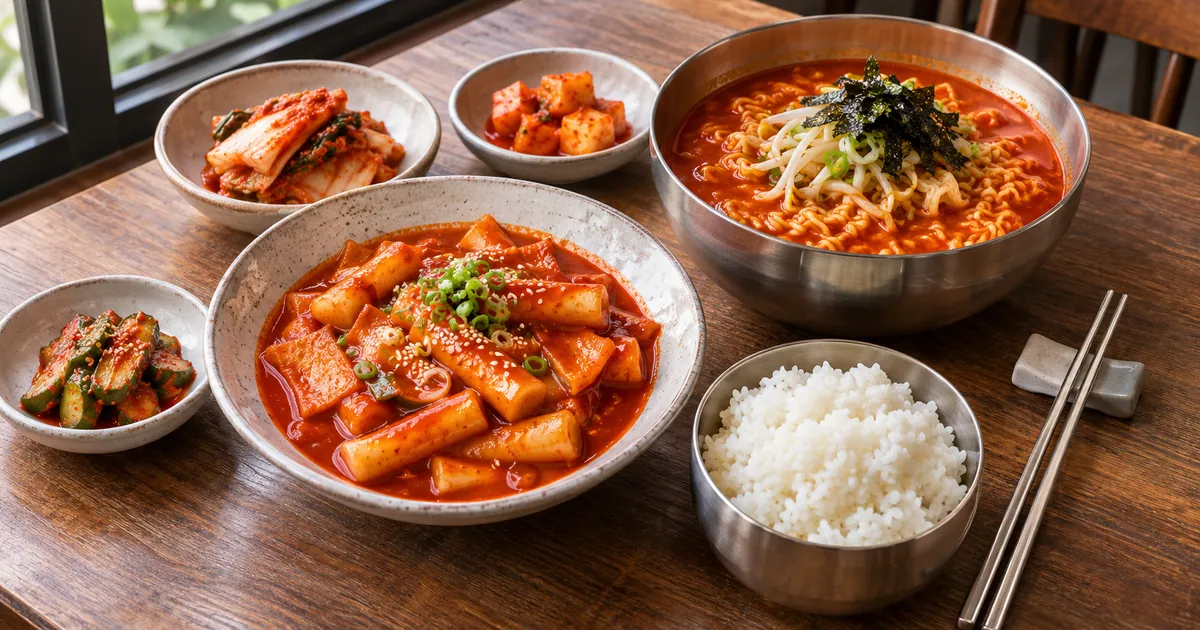
A reader of Your First Six Meals in Seoul sent us a question: “What is the spiciest food in a Korean restaurant?”
There are several possible answers. But before we get to fire chicken and extra-hot rice cakes, there is something useful to know about asking this question in Seoul.
One of our Seoul-born editors sometimes finds the conversation goes like this:
“Is this spicy?”
“About as spicy as Shin Ramyun?”
An entire discussion, settled with a packet of instant noodles.
If you have eaten Shin Ramyun, you now have a reference point. If you have not, the explanation may require another question.
The quick answer
There is no single dish that is always the spiciest food in a Korean restaurant. Buldak (fire chicken), maeun dakbal (spicy chicken feet), and extra-hot versions of tteokbokki, galbijjim and jjamppong are dishes to ask about if you are looking for serious heat.
The restaurant and the version you order matter more than a universal ranking. A familiar dish can be manageable in one kitchen and startling in another. And being Korean does not automatically make someone good at eating it.
“I was born and raised in Seoul, but I still ask for food to be made less spicy. One bite of Buldak noodles can leave me tearful,” says our editor Jiyoung.
“About as spicy as Shin Ramyun?”
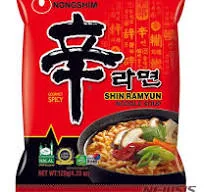
辛 (shin, 매울 신) means “spicy.” Image supplied by the editor.
In our editor’s experience, Shin Ramyun works as an informal point of comparison in everyday conversations about food.
It is a familiar reference rather than a formal measurement. “About Shin Ramyun level” tells someone who knows the noodles more than a vague “a little spicy” might.
That does not mean Shin Ramyun is mild, or that every Korean considers it a comfortable starting point. Familiarity and tolerance are different things.
If you know how you feel about it, you can use that information when ordering:
신라면보다 매워요?
Is it spicier than Shin Ramyun?
Think of this as a way to start the conversation. A soup, a sticky sauce and a plate of stir-fried chicken will still be different eating experiences.
If you have never tried Shin Ramyun, a more useful sentence is:
매운 걸 잘 못 먹어요.
I cannot handle spicy food well.
There is no need to acquire a noodle-based reference system before dinner.
How Buldak took Korean heat around the world
For many people outside Korea, Buldak may be a more familiar reference. Samyang Foods’ Buldak Bokkeum Myeon—the instant noodles associated with “fire noodle” challenges—has made Korean spicy food part of a global conversation. The company says cumulative sales across the noodle range passed 10 billion packs by the end of May 2026.
Buldak was an official Coachella partner in 2025 and returned as an official ramen and hot sauce partner in 2026.

The Buldak booth at Coachella. Image supplied by the editor.

Inside a Buldak booth at Coachella. Image: News Worker / supplied by the editor.
A successful global brand, however, should not be mistaken for a description of everyone’s daily dinner in Korea. Some people love the heat. Some enjoy a little. Others admire the enthusiasm from a respectful distance.
One distinction matters when reading a restaurant menu: buldak, the chicken dish, and Buldak-branded instant noodles are related names, not interchangeable orders. Do not expect the restaurant dish to taste exactly like the packet you know.
Why spicy flavours feel so present in Korean food
Even without ordering an extra-hot speciality, you will encounter chilli in many forms.
There is gochujang, the fermented red chilli paste used in sauces and seasoning, and gochugaru, the red chilli powder or flakes found in many versions of kimchi, stews and vegetable dishes. At a Korean raw-fish meal, you may also encounter chojang, a tangy, sweet chilli sauce often made with gochujang and vinegar.
The seasoning can be central to the dish or something you add at the table. Sometimes you can choose how much to use; sometimes it is already part of the cooking.
You can encounter chilli several times in one meal without ordering anything labelled “extra hot.” At a raw-fish meal, you can decide how much chojang to use. In a stew, the chilli may already be in the broth.
And “spicy” is a broad English word for several things people may be seeking.
Maekomhan (매콤한) can suggest an appetising chilli kick. Eolkeunhan (얼큰한) often describes the warming, spicy character of a soup or stew. Neither is a precise heat rating, but they help explain why someone might want a spicy bowl of soup without wanting an endurance challenge.
The attraction can be the flavour of the whole bowl: savoury broth, chilli, garlic and something warm to eat with rice.
Five dishes to ask about if you want heat
These are possibilities to explore, rather than a ranking from hottest to mildest.
| Dish | What it is | Ask before ordering |
|---|---|---|
| Buldak · 불닭 | Chicken in a fiery sauce | Are there heat levels? |
| Maeun dakbal · 매운 닭발 | Spicy chicken feet with a chewy, gelatinous texture | Are they boneless, and how spicy is this version? |
| Tteokbokki · 떡볶이 | Rice cakes; the familiar red version has a sweet, spicy sauce | Can the spice level be adjusted? |
| Maeun galbijjim · 매운 갈비찜 | Spicy braised ribs | Which heat level would suit the whole table? |
| Jjamppong · 짬뽕 | Noodles in a commonly spicy seafood-and-vegetable broth | Is this the regular version or an extra-hot speciality? |
Tteokbokki deserves particular attention because its appearance as a casual street snack can make visitors underestimate it. The familiar red version is spicy, but the dish also has other styles, including soy-seasoned gungjung tteokbokki. Ask about the version in front of you.
For galbijjim, notice the word maeun, meaning spicy. Sweet, savoury braised ribs and a spicy braised-rib speciality are different dishes, with very different heat levels.
And with jjamppong, remember that the broth may be hot in temperature as well as spicy. Let the first spoonful cool, then taste it.
How to order the heat you actually want
Start by asking whether the kitchen can adjust the dish. Food prepared to order may offer some flexibility. A premixed sauce, marinated ingredient or pot already simmering at a stall may offer less. Ask before ordering rather than assuming chilli can be removed afterwards.
Also distinguish less spicy from not spicy. They are different requests. If a Korean friend says a dish is “not very spicy,” ask what they mean: their reference point may be different from yours.
On a menu, 순한맛 means mild and 매운맛 means spicy. Treat them as descriptions within that restaurant’s range. A numbered scale is similarly local: level two in one restaurant does not establish what level two means elsewhere.
If heat matters to you, a short conversation is more useful than the number alone.
There is plenty to eat without the fire
Korean food includes mild soups, plain grilled meats, rice dishes and noodles alongside its chilli-heavy dishes.
Seolleongtang (ox-bone soup), plain samgyeopsal (grilled pork belly) and mild kalguksu (knife-cut noodle soup) are good places to start. Check the specific preparation and any accompanying sauces; the broad name of a dish will not tell you every ingredient. Our first six meals in Seoul guide includes several gentler places to begin.
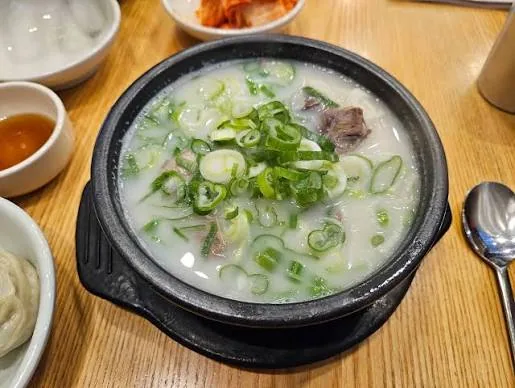
Seolleongtang is one mild soup to ask about when ordering. Image supplied by the editor.
You can keep chilli condiments separate when they are served that way, and choose a restaurant with individual dishes if everyone at your table wants something different.
There is no requirement to build up to Buldak by the end of your trip.
Order for another bite
If you came to Seoul looking for heat, there is plenty to explore. Ask about the dish, understand the restaurant’s scale, and choose something you want to eat beyond its reputation for being hot.
If you came feeling nervous about spicy food, you have options—and at least one Seoul-born editor on your side.
This story began with a reader’s question. Thank you for giving us a reason to explore it. Is there something on a Korean menu you would like us to explain? Send us a question—we may turn it into a future guide.