Reading Korean Skincare Labels
The front of the box is marketing. The back is a legal document. Knowing which is which is the skill.
By A Drop of Seoul Editorial ·
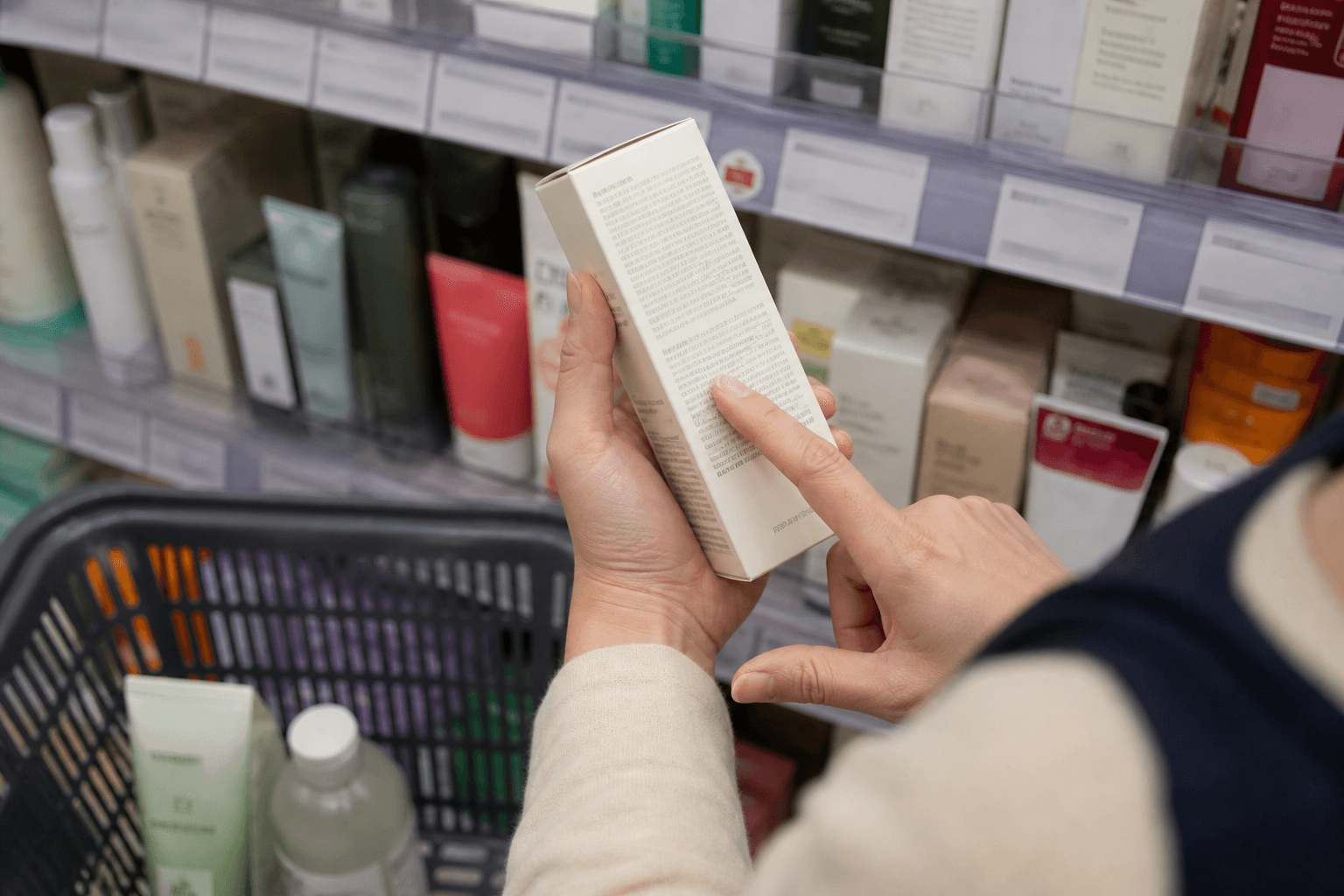
You're holding two jars that look identical. One says 기능성화장품 on it. The other says 저자극 in a nicer font.
One of those words had to be proved to a regulator. The other did not.
That's the whole skill here, and it takes about ten minutes to learn. Korean packaging is unusually informative once you know which half of it is legally meaningful — and unusually good at making the other half look official.
Quick answer
기능성화장품 — gineungseong hwajangpum — is a regulated designation. If it's on the box, the claim was reviewed.
저자극, 무첨가, 클린, EWG 그린등급 are marketing. Some are backed by real testing; none of them mean what a regulated term means.
And the most practically useful thing on any Korean package is the date format, which we'll get to.
The word that actually means something
기능성화장품 translates roughly as "functional cosmetics," and it's a formal category under Korean law. A product in it has been reviewed or reported to the Ministry of Food and Drug Safety for a specific efficacy claim, and by law it must display either the words 기능성화장품 or the designated official symbol — along with the efficacy, usage, and dosage that were actually approved.
The efficacy categories include:
- 미백 (mibaek) — brightening. In practice this targets pigmentation and dark spots rather than overall skin tone, whatever the literal translation suggests.
- 주름개선 (jureum gaeseon) — wrinkle improvement.
- 자외선차단 (jaoeseon chadan) — UV protection. Also covers tanning products.
- 모발의 색상 변화·제거·영양공급 — hair color change, removal, or nourishment.
- Prevention or improvement of dryness, cracking, shedding, and flaking caused by weakened skin or hair function — the group that covers things like scalp and very dry skin claims.
The list has expanded over the years, so treat that as the shape of it rather than an exhaustive index.
Why this matters to you: in most markets, "brightening" and "anti-wrinkle" are free-text marketing words. Here, a product making those claims had to pass through a review to say so. That is a genuinely stronger signal than anything on the front of the box, and almost no English-language K-beauty content mentions it.
What it doesn't mean: that the product will work for you, or that it's better than an unregistered product. Plenty of excellent Korean skincare isn't 기능성 at all, because a good moisturizer isn't claiming to do any of those five things.
The dates, which are the most useful thing on the package
Korean law requires every cosmetic to carry either a use-by date or a period-after-opening. Learn both.
사용기한 (sayonggihan) — use-by date. The product should be used before this date, opened or not.
개봉 후 사용기간 (gaebong hu sayonggigan) — period after opening. Usually shown as the small open-jar symbol with a number: 12M, 24M. The clock starts when you open it, not when you buy it.
제조번호 (jejobeonho) — batch number. Useful if something goes wrong.
And a detail worth knowing: the primary container itself — the tube or jar, not just the outer box — has to carry the product name, the company, the batch number, and the date. So when you throw away the box (everyone does), the important information is still on the thing in your bathroom.
The practical consequence for a trip: a product with a 12M open-jar symbol that you buy and don't open for eight months is fine. A tester-sized item you opened in a hotel and half-used is on a clock. Buy accordingly.
전성분 — the full ingredient list
Korean law requires all ingredients used in manufacturing to be listed, with narrow exceptions for harmless trace amounts defined by ordinance.
This is more useful than it sounds, because the list is ordered by concentration in the usual way — but Korean packaging frequently also prints a percentage for the hero ingredient right on the front. 어성초 77%, 히알루론산 5%. When you see a number, it's telling you something. When a competing product highlights the same ingredient and prints no number, that is also telling you something.
The words that are not regulated
These appear constantly, they're not lies, and they don't carry the weight the design implies.
저자극 (jajageuk) — "low irritation." Usually backed by a real dermatological test, but the brand chooses the test and the panel. It is not a regulatory category.
무향 / 무향료 (muhyang / muhyangnyo) — fragrance-free. This one is genuinely reliable and genuinely useful. 무향 is the phrase to look for if fragrance is your problem, and it's on more Korean packaging than visitors expect.
무첨가 (mucheomga) — "free from additives." Free from which additives? The word alone doesn't say. Look for what follows it.
무알콜 (mualkol) — alcohol-free. Note that fatty alcohols like cetyl alcohol are a different thing entirely and aren't what this refers to.
논코메도제닉 — non-comedogenic. Testing methods vary widely and it predicts less than people assume.
비건 / 더마 / 클린 — vegan, derma, clean. The first has certifiable meaning; the second and third have essentially none. "더마" on a Korean box means the brand is positioning itself as clinical, not that a clinic was involved.
EWG 그린등급 — deserves its own note. EWG is an American non-profit, and its ingredient ratings are widely printed on Korean packaging as a safety signal. It is not a Korean regulator, its methodology is contested, and a green grade tells you about a database entry rather than about a formulation. Treat it as decoration.
The concern words on the front
Short glossary for the words that describe what a product is for:
- 수분 (subun) — hydration
- 진정 (jinjeong) — soothing, calming
- 각질 (gakjil) — dead surface skin; exfoliation
- 모공 (mogong) — pores
- 탄력 (tallyeok) — firmness, elasticity
- 트러블 (teureobeul) — breakouts
- 톤업 (ton-eop) — an immediate cosmetic brightening effect, not a treatment
- 속건조 (sokgeonjo) — dehydrated beneath an oily surface
That last one is the most useful concept in Korean skincare and has no clean English equivalent. We wrote a whole piece on this vocabulary, including 결 and the three kinds of glow.
Three checks, standing in the aisle
One: is there a number? A stated percentage on the front beats a highlighted ingredient name every time.
Two: 기능성화장품 or not? If the product is claiming brightening or wrinkle improvement, that designation should be present. If it's making the claim without it, be curious about why.
Three: which date is it? Use-by or period-after-opening changes how much you should buy. Two of something with a 12M clock is not a saving.
What we'd be skeptical about
Safety-grade badges as a substitute for a formulation. EWG grades, "clean" claims, and long lists of things a product doesn't contain are easier to produce than a good formula.
시카 and 병풀 as a guarantee of gentleness. Centella is a genuinely well-liked soothing ingredient and it appears in products that also contain plenty of things your skin may object to. The presence of a calming hero ingredient doesn't neutralize the rest of the list.
Assuming Korean means gentle. Some of the most heavily marketed products here are potent. Patch test regardless of country of origin — a little on the jawline, once a day, three days, before it goes near your whole face.
Percentages on ingredients where concentration isn't the point. 77% of a plant extract sounds impressive and mostly tells you what the water phase was made of.
Read next
The shopping list version: what to buy for your skin type. The vocabulary of skin itself: what Koreans actually mean by skin texture. Saying it out loud in a shop: Korean phrases for beauty shopping.
FAQ
What does 기능성화장품 mean on Korean cosmetics?
"Functional cosmetics" — a regulated designation under Korean law meaning the product's efficacy claim was reviewed or reported to the Ministry of Food and Drug Safety. Products in the category must show the term or its official symbol along with the approved efficacy and usage.
How do I read the expiry date on Korean skincare?
Look for 사용기한 (a use-by date) or 개봉 후 사용기간 (period after opening, shown as an open-jar symbol with 12M or 24M). Korean law requires one or the other, and the information also appears on the container itself, not only the outer box.
What is 무향 on a Korean product?
Fragrance-free. It's the reliable term to look for if fragrance irritates your skin, and it appears on more Korean packaging than most visitors realize. 무첨가 ("additive-free") is vaguer and worth reading past.
Is an EWG green grade meaningful?
Not as a regulatory signal. EWG is an American non-profit whose ingredient ratings are widely printed on Korean packaging; the grade describes a database entry rather than a finished formulation, and its methodology is disputed. Treat it as marketing.
Do Korean products list all their ingredients?
Yes — Korean law requires the full list of ingredients used, with narrow exceptions for harmless trace amounts. Many products also print the concentration of a headline ingredient on the front, which is more informative than the ingredient name alone.