Korean Phrases for Beauty Shopping (and Salons)
Not a language lesson. About fifteen sentences, and the four that do most of the work.
By A Drop of Seoul Editorial ·
Let's be honest about what this is for.
You do not need Korean to shop in Seoul. Staff at any large beauty store deal with visitors all day, translation apps work, and pointing has never failed anyone. If you learn none of this, you will be fine.
What Korean actually buys you is a change in temperature. The interaction goes from a transaction to something warmer, usually instantly, and often the person will then help you far more than the job requires.
So: about fifteen sentences. Four of them do most of the work.
Quick answer
그냥 볼게요 — geunyang bolgeyo — "I'm just looking." 얼마예요? — eolmayeyo? — "how much is it?" 이거 발라봐도 돼요? — igeo ballabwado dwaeyo? — "can I try this on?" 감사합니다 — gamsahamnida — "thank you."
If you only take four, take those. The first one is the most useful sentence in this article and we'll explain why.
Someone will offer to help. Here's how to decline warmly.
Walk into any Korean beauty store and within a minute you'll hear:
도와드릴까요? — dowa-deurilkkayo? — "can I help you?"
The reflex for most visitors is to freeze, or to say "no" in English, which lands flatter than intended. The local answer is:
그냥 볼게요 — geunyang bolgeyo — literally "I'll just look."
It is polite, it is exactly what Koreans say, and it ends the conversation warmly rather than shutting it down. Add 감사합니다 and you're done. Nobody will follow you.
If you'd rather have the help, the opposite works too:
네, 도와주세요 — ne, dowajuseyo — "yes, please help me."
Getting someone's attention
Not 아줌마. Not 아저씨. Those are age-and-role words and they land badly from a stranger.
저기요 — jeogiyo — the all-purpose "excuse me." Slight rising tone, said toward the person, not shouted. This is what everyone here uses and it works in shops, restaurants, and salons.
Asking about a product
이거 뭐예요? — igeo mwoyeyo? — "what is this?"
얼마예요? — eolmayeyo? — "how much is it?"
테스터 있어요? — teseuteo isseoyo? — "do you have a tester?" (테스터 is the English word, said the Korean way.)
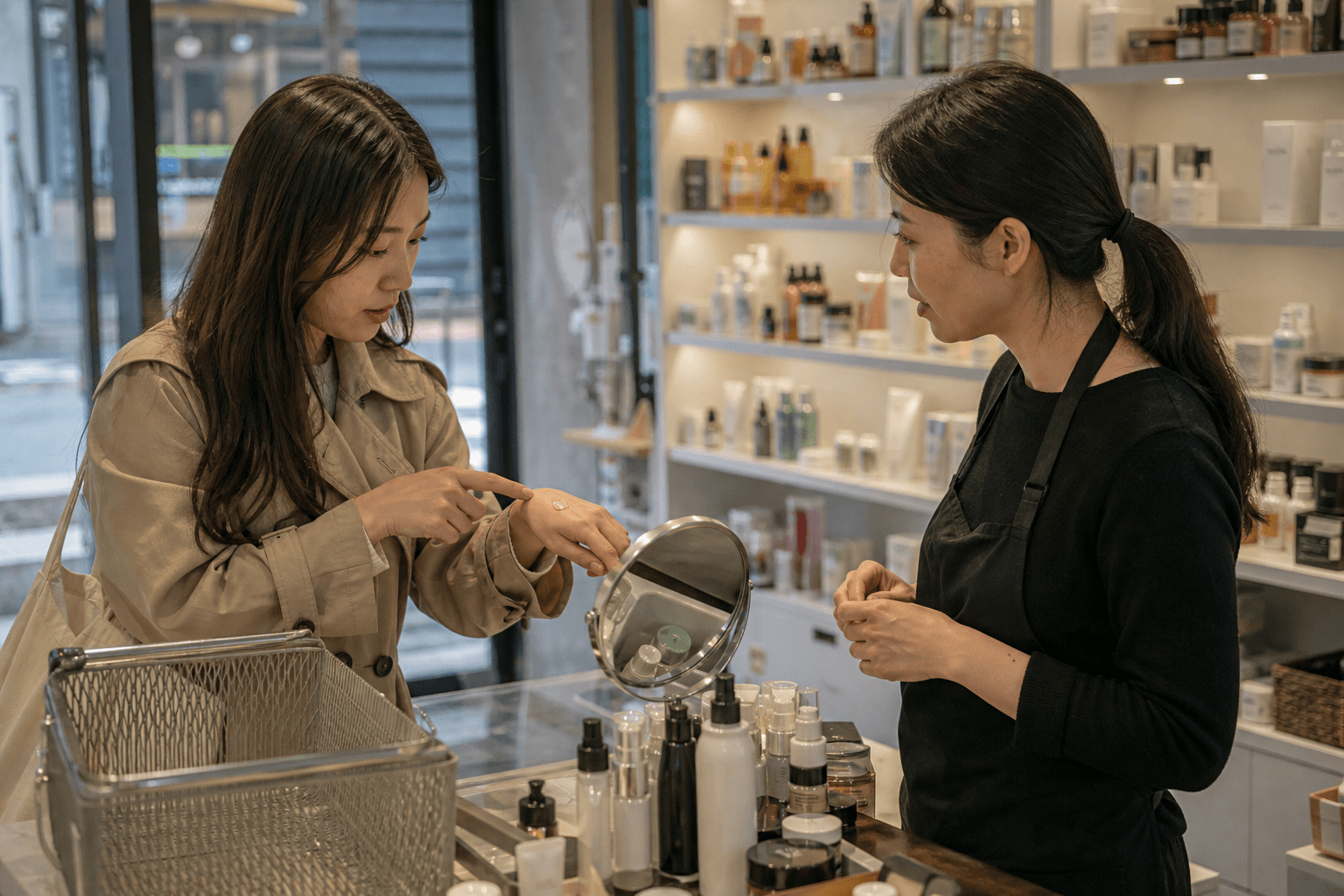
발라봐도 돼요? — ballabwado dwaeyo? — "can I try it on?" Literally "may I apply it." This is the one for skincare and makeup specifically.
더 큰 거 있어요? — deo keun geo isseoyo? — "do you have a bigger size?"
향 없는 거 있어요? — hyang eomneun geo isseoyo? — "do you have a fragrance-free one?" Genuinely useful, and a question most visitors don't know how to ask.
Saying what your skin is
Four words cover the standard categories, and staff will immediately narrow the shelf for you:
- 건성 — geonseong — dry
- 지성 — jiseong — oily
- 복합성 — bokhapseong — combination
- 민감성 — mingamseong — sensitive
Put it together: 저는 민감성이에요 — jeoneun mingamseong-ieyo — "I have sensitive skin."
Two more worth having:
트러블 — teureobeul — breakouts. It's from the English "trouble" and it's the normal word here.
속건조 — sokgeonjo — oily on the surface, dehydrated underneath. There's no clean English equivalent, it's an everyday word in Korea, and saying it will visibly change the recommendation you get. We wrote about why that concept matters.
Price and promotions
이거 1+1이에요? — igeo won peulleoseo won-ieyo? — "is this buy-one-get-one?"
The tag is the thing to look for rather than the question, and how the 1+1 system actually works is worth reading before you shop. But it's useful to be able to confirm.
세일해요? — seil-haeyo? — "is this on sale?"
At the register
봉투 주세요 — bongtu juseyo — "a bag, please." Bags are charged for and are not offered by default.
봉투 필요 없어요 — bongtu piryo eopseoyo — "I don't need a bag."
카드로 할게요 — kadeuro halgeyo — "I'll pay by card." Cards work everywhere; this is what most people say.
택스 리펀 돼요? — taekseu ripeon dwaeyo? — "does tax refund work here?" Say this before they start scanning. Undoing a completed transaction is a whole production.
적립 안 해요 — jeongnip an haeyo — "no points card." The membership system is built for people with a Korean phone number; declining quickly saves everyone time.
In a salon chair
This is where a few words are worth much more than in a shop, because the stakes are your hair.
예약했어요 — yeyakhaesseoyo — "I have a reservation."
다듬어 주세요 — dadeumeo juseyo — "just a trim, please." The single most important sentence here.
조금만 잘라주세요 — jogeumman jallajuseyo — "only cut a little."
이렇게 해주세요 — ireoke haejuseyo — "like this, please." Say it while showing a photo. Bring photos. Bring more photos than you think you need — this is universal advice in every country and it is not less true here.
Where we'd book, by neighborhood.
During any treatment — the important ones
At a head spa, a facial, or a bathhouse scrub, these matter more than anything else on this page.
아파요 — apayo — "it hurts." Two syllables. Learn this one.
약하게 해주세요 — yakhage haejuseyo — "gentler, please."
세게 해주세요 — sege haejuseyo — "stronger, please."
좋아요 — joayo — "that's good." Useful for confirming pressure is right, which staff will often check.
The bathhouse scrub — 세신, sesin — is genuinely vigorous, and people frequently endure it silently because they don't know how to ask for less. You do now. The jjimjilbang guide covers the rest, and what happens at a head spa covers that.
When it isn't working
영어 돼요? — yeongeo dwaeyo? — "do you speak English?"
천천히 말해 주세요 — cheoncheonhi malhae juseyo — "please speak slowly." More useful than it sounds, because the usual problem isn't vocabulary, it's speed.
잘 모르겠어요 — jal moreugesseoyo — "I don't really know / I don't understand." Softer and more natural than a flat "no."
Four things nobody tells you
Romanization is a lie, and that's fine. Korean has vowels — 어 and 으 in particular — with no English equivalent, so anything written in Latin letters is an approximation. Use a translation app's audio once for each phrase and your version will be closer than any spelling could get you. Nobody expects accuracy; the attempt is the point.
You will not accidentally be rude. Korean has politeness levels, and visitors worry about this far more than they should. Every phrase above ends in -요, which is the polite everyday register. It is correct with a shop assistant, a stylist, and someone's grandmother. You cannot get in trouble with -요.
Don't apologize for your Korean. People say 한국어 잘 못해요 as a preamble and then deliver a perfect sentence. Just say the sentence.
They'll probably switch to English. In tourist-facing areas, using Korean often prompts a friendly switch to English, which can feel like a failure. It isn't. The temperature already changed. That was the whole objective.
The pocket version
If you're going to screenshot one thing:
저기요 — jeogiyo — excuse me 그냥 볼게요 — geunyang bolgeyo — just looking 얼마예요? — eolmayeyo? — how much? 발라봐도 돼요? — ballabwado dwaeyo? — can I try it? 봉투 주세요 — bongtu juseyo — a bag, please 아파요 — apayo — it hurts 감사합니다 — gamsahamnida — thank you
Seven lines. That's a shopping day, a salon appointment, and a bathhouse.
Read next
The store itself: Olive Young, explained and what we'd actually buy there. Booking a service: a beauty lover's day in Gangnam. The vocabulary behind the products: what Koreans actually mean by skin texture.
FAQ
Do I need to speak Korean to shop for beauty in Seoul?
No. Large stores and visitor-facing salons handle English routinely, and pointing works. A handful of Korean phrases changes the tone of the interaction rather than its outcome — which is a good enough reason on its own.
How do I say "I'm just looking" in Korean?
그냥 볼게요 — geunyang bolgeyo. It's the standard, polite way to decline help without ending the conversation coldly, and it's what Koreans say themselves.
How do I ask to try a product?
발라봐도 돼요? — ballabwado dwaeyo? — "can I try it on," used for skincare and makeup. For a tester specifically, 테스터 있어요? — teseuteo isseoyo?
What should I say if a Korean scrub or massage hurts?
아파요 — apayo — "it hurts," or 약하게 해주세요 — yakhage haejuseyo — "gentler, please." Bathhouse scrubs are vigorous by design, and staff will adjust immediately if asked.
Will I be rude if I get the politeness level wrong?
Practically, no. Every phrase here ends in -요, the standard polite register, which is appropriate with shop staff, stylists, and strangers of any age. Visitors worry about this far more than the situation warrants.