Olive Young, Explained by People Who Shop There for Cotton Pads
The store your friends keep asking about, answered the way we answer it over text.
By A Drop of Seoul Editorial ·
The message always arrives from the airport. Which Olive Young should I go to? — as if there were one, as if choosing wrong would ruin the trip.
We should say up front that we are not neutral about this store. We buy cotton pads there. We buy sunscreen there in August when it runs out. It is a pharmacy-adjacent errand shop that happens to be very good at beauty, and the mythology that has grown around it abroad is a little funny from the inside.
Still. If you have one afternoon and a suitcase with room in it, here is what we'd tell you.
Quick answer
Any large branch is fine — Myeongdong, Hongdae, Gangnam, or Seongsu. Do one full lap before you pick anything up, because the real discount is the 1+1 tag, not the shelf price. Bring your passport for the tax refund and say so before the cashier starts scanning. Buy sunscreen, cleansers, toner pads, and masks. Buy your hair clips and cheap tools at Daiso instead.
First, the name
올리브영, ol-li-beu-yeong. Nobody says the whole thing. Among ourselves it's 올영, ol-yeong — the way you'd shorten any shop you walk past four times a week.
That shortening tells you what it is here. Not a destination. The place you duck into because your sunscreen ran out and there is one across from the subway exit.
Which branch, honestly
They are not interchangeable, but the difference is size, not quality. Prices are set chain-wide, so there is no cheaper branch to hunt for.
A small corner branch stocks what people grab on the way home: cleanser, masks, sunscreen, hair ties, painkillers, socks sometimes. A flagship stocks the long tail — the brands that launched last month, the big sizes, the tools, the gift sets.
If you get one shopping window, go to a flagship. Myeongdong has the biggest and the busiest, and the staff there deal with visitors all day, which helps. Hongdae and Gangnam are nearly as deep with a fraction of the noise. Seongsu only makes sense if you were already going — and if you are, our Seongsu beauty and bites walk is built around that afternoon.
One thing guidebooks never mention: go in the late morning. Myeongdong branches turn unpleasant around four in the afternoon, when tour groups and people finishing work arrive at the same time and the aisles stop being aisles.
The 1+1 tag is the whole game
This is the part worth reading twice.
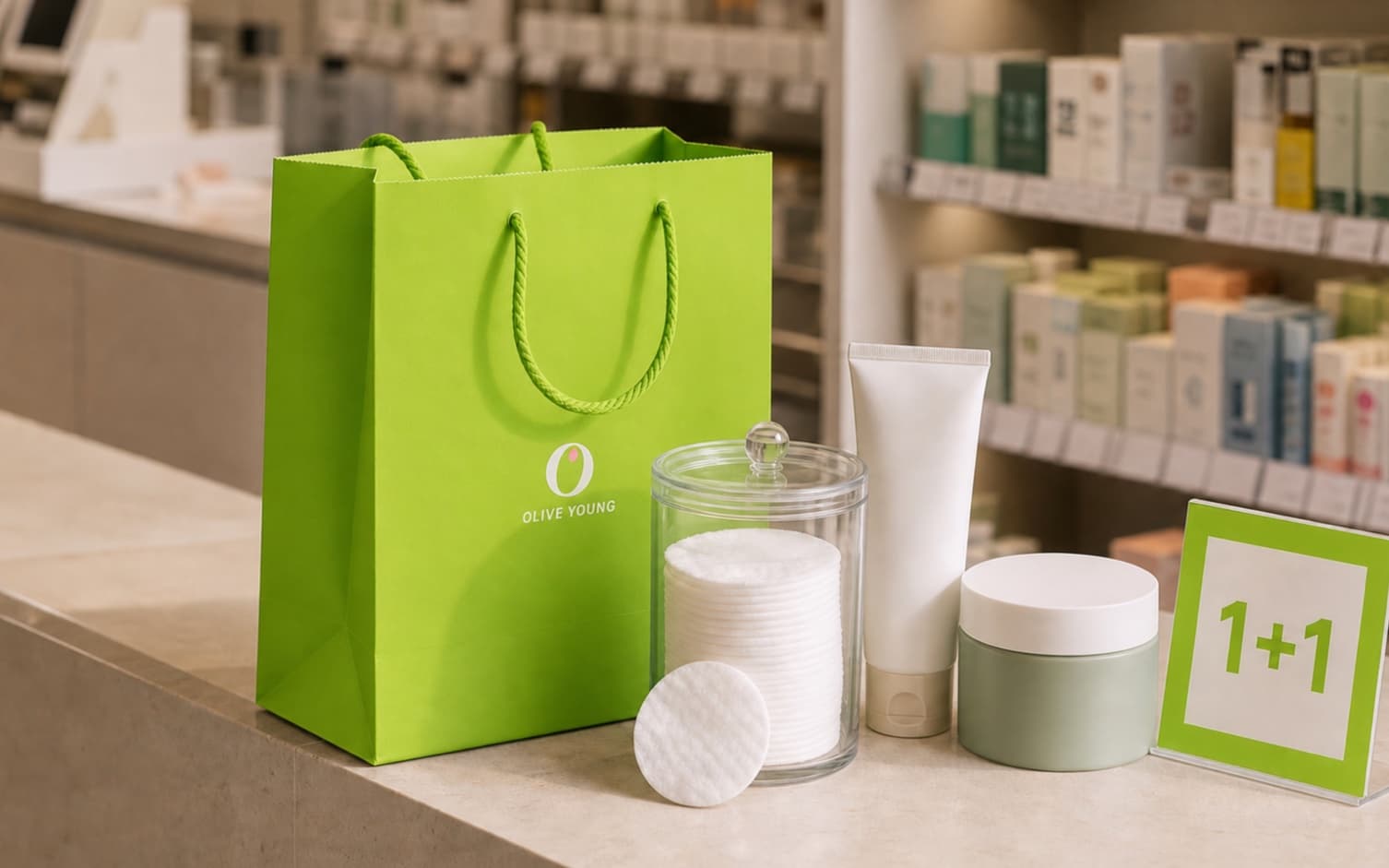
Look for 1+1 (원 플러스 원, won peulleoseu won) and 2+1 on the shelf tags. Buy one, get one. Buy two, get three. They rotate constantly, they're brand-specific, and they are usually a better deal than any percentage discount printed nearby.
Which leads to the one rule we actually enforce on visiting friends: walk the entire floor before you buy anything. The serum you picked up in the first aisle is frequently sitting under a 1+1 tag in the promo bay by the registers. We have watched people pay full price for something that was two-for-one eleven steps away.
The counter-rule: do not let a 1+1 tag talk you into two bottles of something you have never put on your face. Two of the wrong thing is not a saving, it is two of the wrong thing. Buy one, test it, and reorder later — Olive Young ships internationally now, which most visitors don't realize until they're home.
As for the membership points and app coupons: skip it. That system is built for people with a Korean phone number and a residency-shaped life. Watching a tourist try to register at the counter while a queue forms behind them is its own small tragedy.
Tax refund, minus the folklore
Foreign visitors can get Korean VAT back, and the bigger branches handle it right at the register instead of sending you to an airport counter.
Three things hold true:
- Bring the actual passport. A photo on your phone is not it.
- Say it before they scan. 택스 리펀 돼요? — taekseu ripeon dwaeyo? — "does tax refund work here?" Undoing a finished transaction is a whole thing.
- The discount comes off right there, so the number on the card reader is already lower.
What does not hold: the minimum spend, the cap, and which items count. Those get revised, and any guide quoting you exact figures is quoting the year it was written. Ask at the counter, or check Visit Korea before you fly. If you're near the ceiling, split it across two visits rather than engineering one enormous receipt.
What we'd actually put in your basket
The test isn't "is it Korean." It's whether it's meaningfully cheaper or better here.
Sunscreen — the strongest case in the building. Korean daily SPF has textures the rest of the world is still catching up to, and the price gap is not subtle. Buy several. Our sunscreen guide by skin type will narrow it down.
Cleansers. Low-pH gels, oils, balms. Cheap, and you can feel the textures on the shelf.
Toner pads. Heavy to ship, cheap to carry, genuinely useful — see toner pads as mini masks.
Masks and barrier creams. Masks by the box, not by the handful of singles. For creams, look for ceramide NP, panthenol, or centella asiatica printed on the front.
What to skip, including one heresy
International brands — no cheaper here, sometimes worse. Devices, unless you already know the model and the voltage. Gift sets, which are one good product and four passengers.
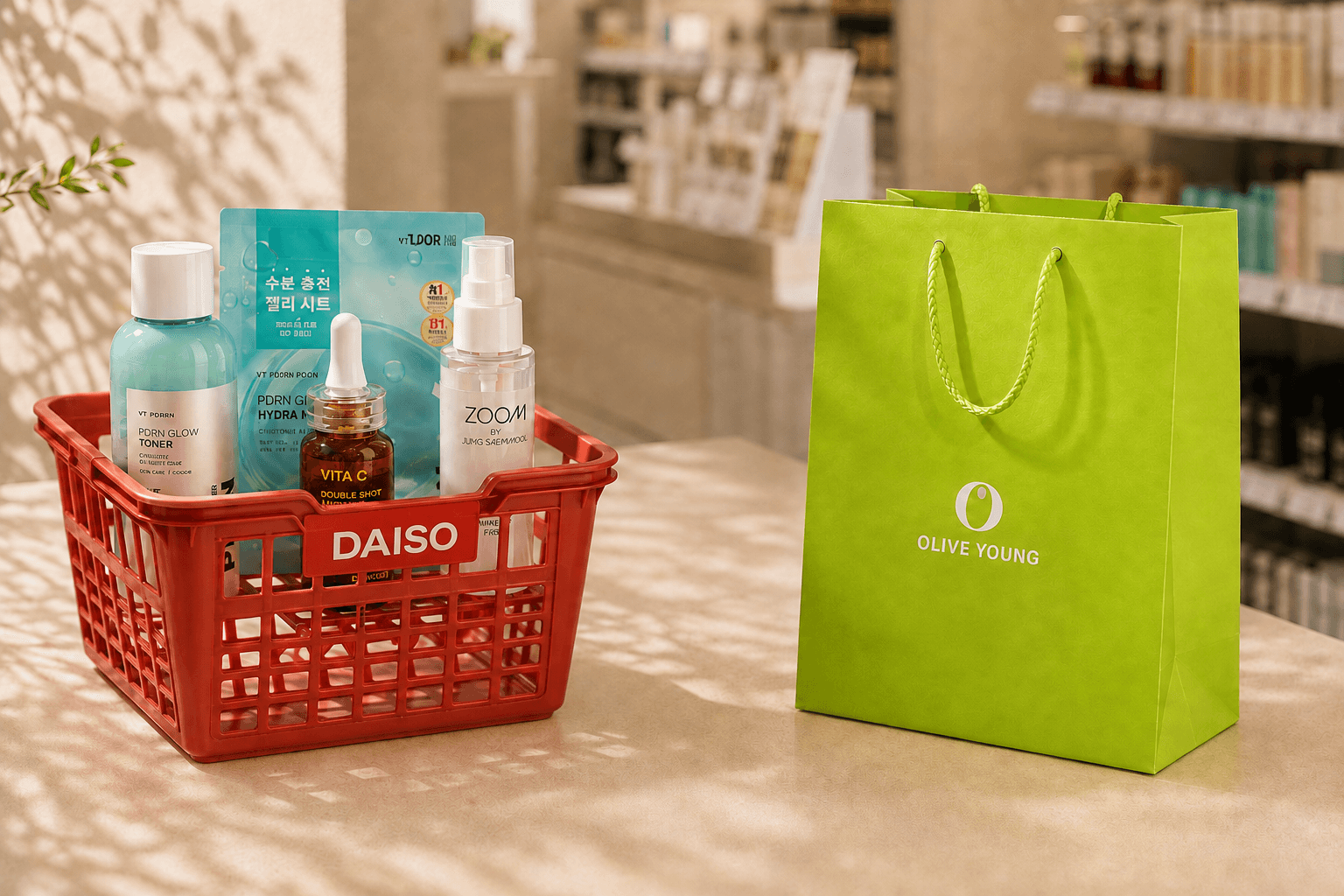
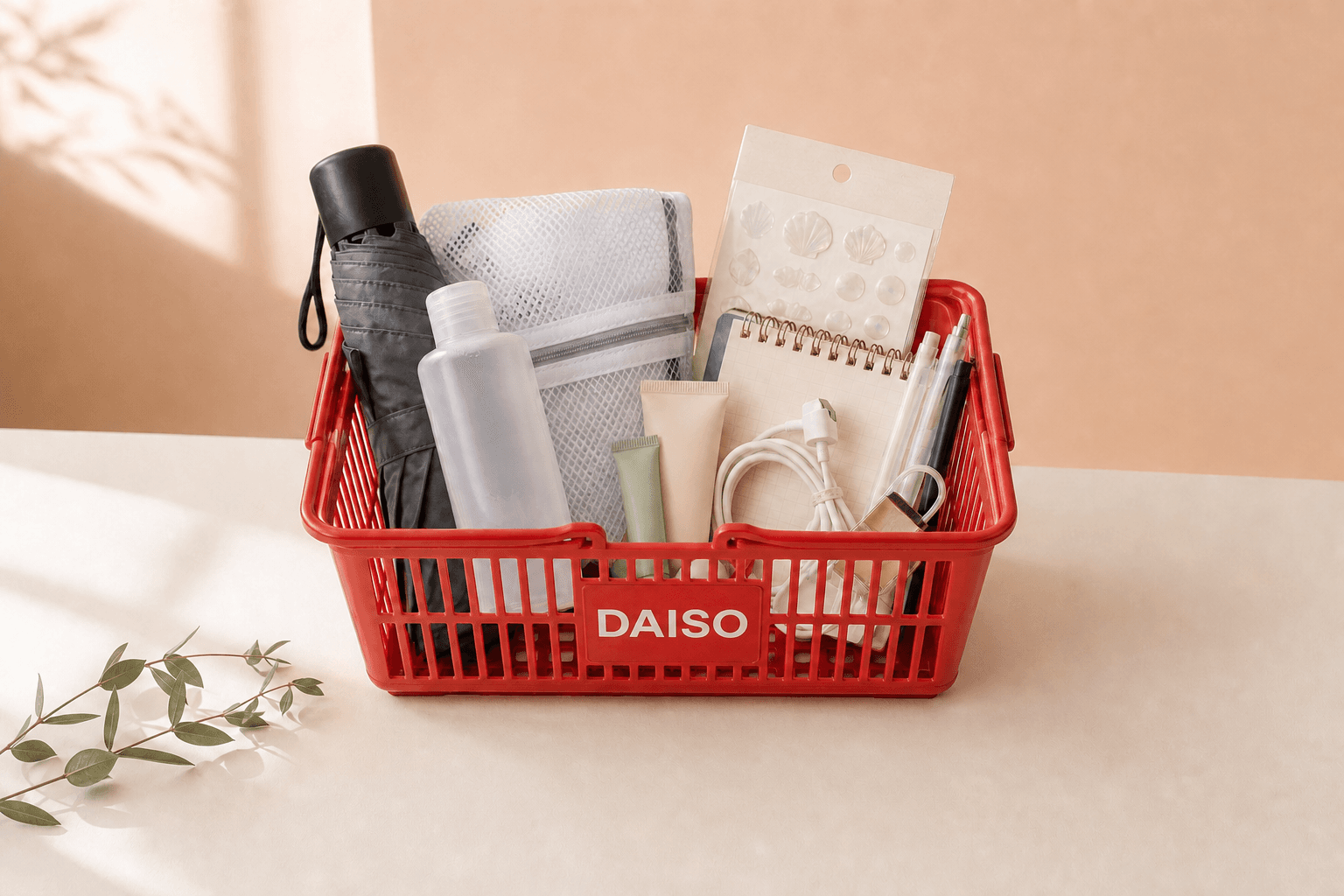
And the heresy: buy your tools at Daiso. Hair clips, headbands, cotton pads, foot files, the little silicone brushes — all of it is a fraction of the price two doors down, and it's the same stuff. There is a Daiso near every Olive Young. Koreans do this constantly. Nobody tells visitors.
Also, please don't shop for other people's faces. A cream that suits your friend's dry Chicago winter can be the wrong call entirely; what to buy for your skin type covers that first.
If someone comes over to help
They will. 도와드릴까요? — dowa-deurilkkayo? — "can I help you?"
You can just say 그냥 볼게요, geunyang bolgeyo: "I'm just looking." It is polite, it is what we say, and it ends the conversation warmly. More phrases here if you want a few in your pocket.
Thirty minutes, four decisions
Lap the floor with your hands empty. Note where the 1+1 bays are. Then go back for: one sunscreen, one cleanser, one thing for whatever your skin is doing right now, and one bulk buy — masks or pads. Ask about the refund before you pay.
That's it. You can always come back. There is another branch two blocks away, and there always will be.
Read next
Deciding between the two big shopping neighborhoods? Myeongdong vs Seongsu. Still working out what your skin needs? Start with the Korean skincare routine by skin type.
FAQ
Is Olive Young cheaper than buying Korean skincare abroad?
For Korean brands, usually yes, and often by a lot once 1+1 promotions are counted. For international brands, no. The saving sits in the categories Korea makes well and prices competitively: sunscreen, cleansers, masks, toner pads.
Which Olive Young in Seoul is best?
The large Myeongdong branches carry the most and are the most used to visitors, but they are also the most crowded. Hongdae and Gangnam flagships are the better trade-off. Small neighborhood branches are for basics only. Prices are the same everywhere.
Can I get a tax refund at Olive Young?
Yes, at branches offering immediate refunds. Bring your physical passport and mention it before the cashier starts scanning. Minimum spends and caps change periodically, so confirm the current numbers in store.
What does 1+1 mean at Olive Young?
Buy one, get one free — the second is included at the tag price. 2+1 means buy two, get three. They rotate by brand and usually beat the percentage discounts nearby.
Do I need cash?
No. Cards work everywhere and that's how most of us pay. Keep a little cash for older cafés and markets elsewhere in the city.
Is Olive Young where Koreans actually shop?
For everyday things, yes — sunscreen, cleanser, masks, pads. It is an errand, not an event. Tools and cheap accessories we mostly buy at Daiso, and anything serious about skin usually starts at a dermatologist rather than a shelf.