What Korean Women Actually Mean by \"Skin Texture\"
결 doesn't mean texture. It means grain — like wood, like fabric. That difference reorganizes everything.
By A Drop of Seoul Editorial ·
The first time someone here tells you your 피부결 is good, it lands strangely. It sounds like a comment about your pores.
It isn't. And the reason the compliment doesn't quite translate is that English skincare has one word — texture — doing a job that Korean splits across several, all of which are about light rather than flaws.
Once you have the actual words, a lot of things stop being mysterious. Why the sunscreen aisle is organized the way it is. Why "glass skin" was always a slightly wrong translation. Why someone with visibly oily skin here will tell you, with total conviction, that their skin is dry.
Quick answer
결 (gyeol) means grain — the way you'd say the grain of wood or the weave of fabric. 피부결 is the fineness and evenness of the skin's surface, judged by how light moves across it.
That's the key difference. In English, "texture" is usually a complaint — bumps, roughness, something to correct. In Korean, 결 is a quality you can have more or less of, and the goal is to refine it, not eliminate it.
The word English is missing: 속건조
Start here, because this one changes what you buy.
속건조 (sok-geonjo) means "inner dryness" — skin that is oily on the surface and dehydrated underneath. English has "dehydrated skin," which is close, but it's a term you find in dermatology writing rather than in ordinary conversation. In Korea, 속건조 is something people say about themselves casually, the way you'd mention being tired.
Its existence as an everyday word does real work. It means a lot of people here never fall into the trap of treating oiliness by stripping — because they've been given a concept in which oil and dryness are not opposites. Skin over-produces oil because it's dehydrated. The answer is water, not more foam cleanser.
If you've spent years using mattifying products and wondering why your skin got shinier, this is the word you were missing.
The three glows, and why they're not the same
광 (gwang) is light off skin. Korean splits it into at least three, and people use the distinctions precisely.
물광 (mul-gwang) — water glow. Skin that looks like it's holding water. The glow comes from the whole face rather than from placed highlights, and it depends on skin condition rather than product. This is the one you can't fake; if the skin underneath isn't hydrated, 물광 makeup just reads as greasy.
윤광 (yun-gwang) — refined gloss. A thinner, more controlled reflection, like light off a film. This one is constructible — with base products, contour, and highlighter, you decide where the light lands and where it doesn't.
꿀광 (kkul-gwang) — honey glow. Warmer and softer than either. Less about wetness, more about a rich, lit-from-within finish.
And then a fourth that ties it back:
결광 (gyeol-gwang) — grain glow. The glow that comes from the surface being genuinely smooth, so light reflects evenly. Not applied. Earned.
That last one is the actual goal of most Korean skincare, and it explains why so much of the routine here is about hydration, gentle exfoliation, and barrier stability rather than about a single dramatic active. You are not trying to add shine. You are trying to make a surface even enough that shine happens on its own.
Why "glass skin" was always a slightly wrong translation
유리 피부 — glass skin — became the export term, and it's not wrong exactly, but it landed abroad as a look: extremely dewy, very filtered, achieved with layers.
Domestically the same idea is much closer to 결광. Not wet. Even. A pane of glass isn't shiny because it's damp; it's shiny because it's flat and uniform.
That distinction is why so many people abroad chase glass skin by adding layers of hydrating product and end up sticky rather than luminous. Glass skin without the 10 steps and what actually works both come at this from the practical side.
The rest of the vocabulary, quickly
- 각질 (gakjil) — dead surface skin, flaking. What exfoliation is for.
- 모공 (mogong) — pores. Usually discussed as visibility rather than as a thing to "close."
- 들뜸 (deultteum) — literally "lifting." What makeup does when it clings to dry patches and separates. The single most common complaint here, and always treated as a skincare problem rather than a makeup one.
- 번들거림 (beondeulgeorim) — greasy shine, the bad kind. The opposite of 광, not a version of it.
- 진정 (jinjeong) — soothing, calming. On a startling number of packages.
- 생기 (saenggi) — vitality, liveliness. What people say a good routine gives you when they don't mean glow specifically.
- 톤 (ton) — tone, meaning evenness of color. Deliberately kept separate from 결.
That last separation is worth sitting with. Korean beauty conversation treats tone and grain as two independent axes. You can have even tone and rough grain, or fine grain and uneven tone, and they call for different products. English tends to collapse both into "texture and tone" as a single phrase, which is why so much Western product copy promises to fix both with one thing.
What this actually changes about shopping
Three practical consequences.
You'll stop over-cleansing. If oiliness might be 속건조, the answer isn't a stronger cleanser. It's a gentler one and more water underneath. Our routine by skin type sorts out which case you're in.
You'll buy hydration before you buy actives. Fine grain comes from a stable, hydrated, unirritated surface. Actives can help eventually; they can't substitute.
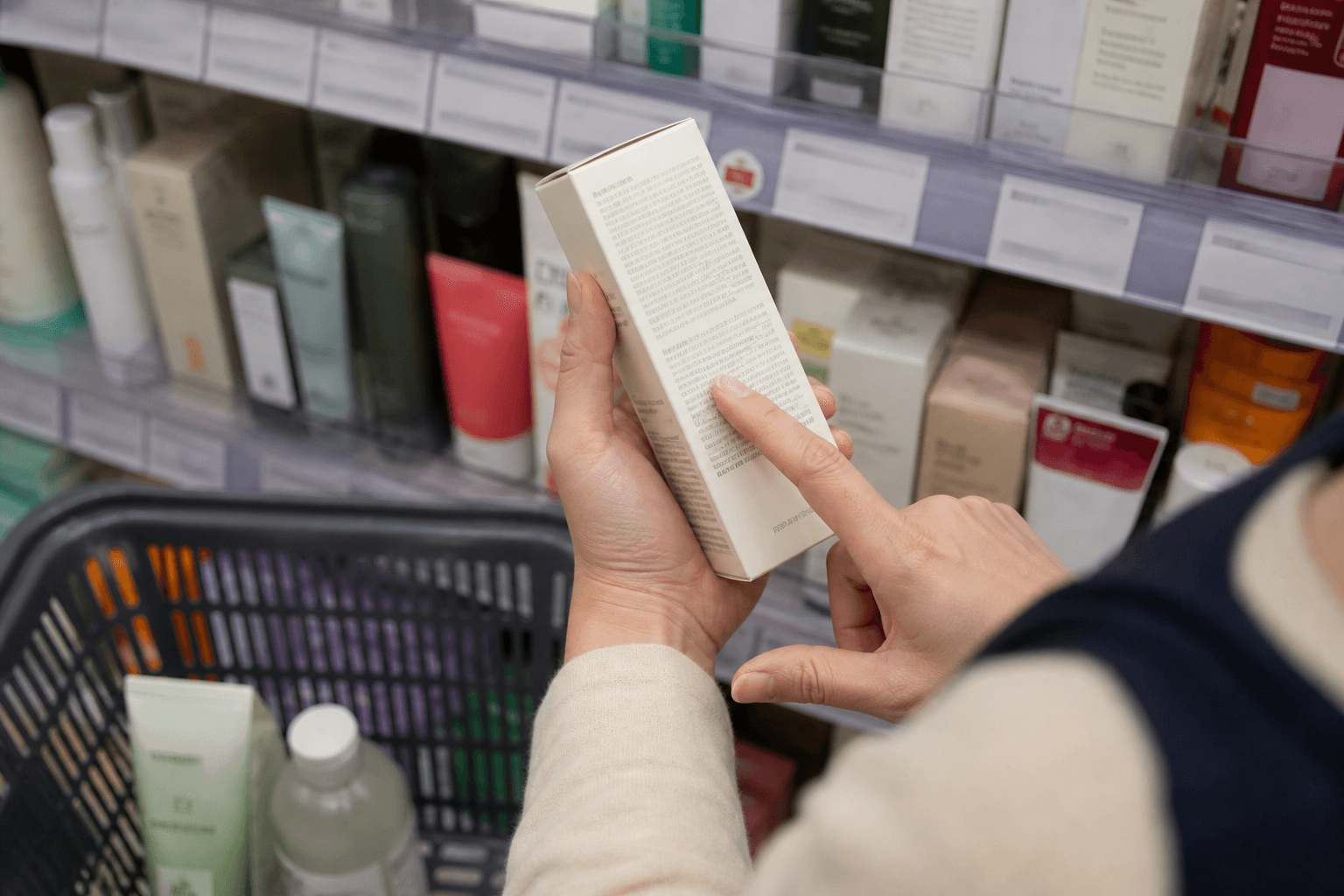
You'll read packaging better. 진정 (soothing) and 수분 (moisture) on a Korean package tell you what the product is for far more reliably than the English on the back, which is often written for export.
The part we'd push back on
This vocabulary is precise, useful, and we genuinely like it. It also comes attached to a standard.
Having a rich, specific language for the surface of your face means having a rich, specific language for everything that's wrong with it. 들뜸, 번들거림, 각질, 모공 — those are all words for noticing. And a culture that notices this precisely is also a culture where people notice each other this precisely.
Take the concepts. They'll make you better at buying skincare and much better at understanding what a Korean product is actually promising. Feel free to leave the scrutiny behind.
Read next
The practical version: glass skin without the 10 steps. Working out your own case? The Korean skincare routine by skin type. If your barrier is the problem: the Korean barrier repair routine.
FAQ
What does 피부결 mean?
Literally "skin grain" — 결 is the word for the grain of wood or the weave of fabric. It refers to the fineness and evenness of the skin's surface, assessed by how light travels across it. It's a quality to refine rather than a flaw to remove, which is how "texture" usually functions in English skincare.
What is 속건조?
Inner dryness — skin that is oily on the surface but dehydrated underneath. It's an everyday word in Korea rather than a technical one, and it's the reason the local instinct for oily skin is more hydration rather than stronger cleansing.
What's the difference between 물광 and 윤광?
물광 (water glow) is a whole-face, moisture-driven luminosity that depends on skin condition and can't really be faked. 윤광 (refined gloss) is a thinner, controlled reflection that can be constructed with base makeup, contour, and highlighter.
Is glass skin the same as 유리 피부?
Same term, different emphasis. Abroad it's been read as extremely dewy. Domestically the idea is closer to evenness — a pane of glass reflects light because it's uniform, not because it's wet. Chasing dewiness with more layers is the most common way people get it wrong.
Do I need to know Korean to shop for Korean skincare?
No, but four words help a lot on packaging: 수분 (moisture), 진정 (soothing), 각질 (dead skin/exfoliation), and 결 (grain/texture). Korean front-of-package copy is usually more specific about a product's job than the exported English on the back.