The Korean Hair Brands Worth Knowing
Nine names, sorted by the job they do — not by how loudly they market.
By A Drop of Seoul Editorial ·
Most brand lists in this category are ranked by fame, which is useless, because the four most famous Korean hair brands do four completely different jobs and two of them probably aren't yours.
So here they are sorted the other way — by the problem they exist to solve. Find your problem, then find the brand.
One thing to notice as you read: Korean skincare has been taken over by indie brands, to the point that around three-quarters of Olive Young's category winners are now small and mid-size companies. Haircare didn't go that way. It's still largely two conglomerates — plus one independent that beat them both at their own game.
Quick answer
Damaged hair → UNOVE. Scalp and shedding → LABO-H or Dr.Groot. Traditional herbal → Ryo. What your Korean stylist actually uses → AMOS. Cheap and everywhere → Mise en Scène. You want it to smell incredible → Kundal.
If you're only buying one thing, buy the UNOVE treatment. Here's why we'd start there.
For damage
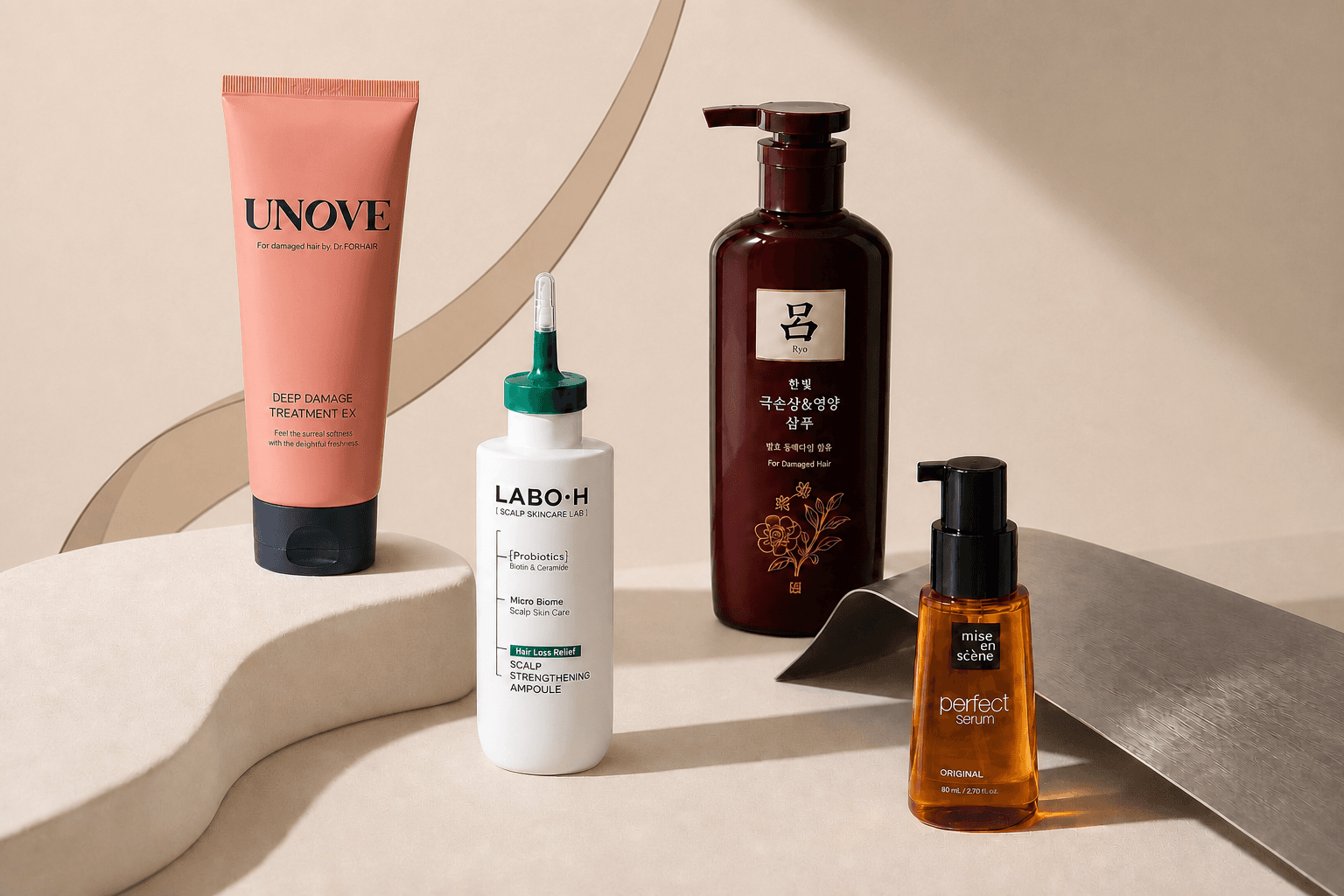
UNOVE (어노브)
Known for: deep damage repair, in a tube, at drugstore prices.
The record: its Deep Damage Treatment EX has taken first place in Olive Young's haircare category four years running. In the 2025 awards its shampoo also placed second in shampoo and its Silk Oil Essence third in hair essence. One brand, three podiums.
The interesting part: UNOVE launched in 2021 from Wyatt, the independent company behind Dr.FORHAIR. Not Amorepacific. Not LG. An independent that walked into the most conglomerate-dominated aisle in Korean beauty and has been winning it since.
Who it's for: bleached, colored, heat-damaged, or just tired mid-lengths. If your hair has been through something, start here.
What we'd try: the Deep Damage Treatment EX. That's the one.
JSOOP (제이숲)
Known for: professional-feeling treatments with the salon vocabulary intact.
Who it's for: people who've used UNOVE, liked it, and want to go a step heavier. The Red J treatment is the flagship; the Purple J pack is the one people repurchase in the big size.
Honest note: the difference between this tier and the drugstore tier is real but incremental. Don't start here.
For the scalp
LABO-H (라보에이치)
Known for: building an entire brand on one sentence — the scalp is skin — and then formulating like it, probiotics and all.
Who it's for: shedding, thinning, or a scalp that feels tight and unhappy. It's the best-selling hair-loss care brand in Korea, which in a market this crowded means something.
What we'd try: the scalp-strengthening shampoo, or better, the ampoule — it's the more distinctly Korean product of the two.
Owned by: Amorepacific, alongside Ryo and Mise en Scène.
Dr.Groot (닥터그루트)
Known for: being the default. Six consecutive years at the top of Korea's functional hair-loss shampoo share, more than 40 million cumulative bottles sold.
Who it's for: anyone who wants the mainstream, well-tested option rather than the interesting one. It's now in roughly 600 Costco stores in North America, which tells you both that it works for a broad audience and that you may not need to carry it home.
Owned by: LG Household & Health Care.
Dr.FORHAIR (닥터포헤어)
Known for: the most segmented hair-loss lineup on the shelf — a different formula for oily scalps, dry scalps, dandruff, postpartum shedding.
Who it's for: people who already know their specific scalp situation and want to match it precisely. If you don't, that segmentation is just confusing, and you should be at Dr.Groot instead.
Same parent as UNOVE, which is a genuinely useful thing to know: one company owns both the best damage brand and one of the best scalp brands.
For tradition
Ryo (려)
Known for: hanbang — the Korean herbal-medicine tradition applied to hair. Korean red ginseng, red pine.
Who it's for: people who want the version of Korean haircare that feels culturally specific rather than clinically specific. It's also the easiest of these to find outside Korea.
Honest note: the herbal framing is real heritage, not invented marketing — Ryo has been at this since 2008 under Amorepacific. Whether ginseng outperforms a well-formulated conventional scalp tonic is a separate question, and we'd say the honest answer is "not dramatically."
For salons
AMOS Professional (아모스프로페셔널)
Known for: being the one on the shelf behind your Korean stylist, not the one on the shelf in front of you.
AMOS has been salon-channel since 1976 and stays there. You mostly can't buy it at Olive Young. If you've had a good haircut in Seoul, there's a reasonable chance something green-tea-scented from this line went on your head.
Who it's for: people who liked the treatment they got at a Korean salon and want to know what it was. Ask at the salon — they'll usually sell it to you directly.
For everyday
Mise en Scène (미쟝센)
Known for: the Perfect Serum, and for essentially inventing the modern Korean hair aisle. It launched in 2000 as Korea's first hair color to include a serum, then expanded into styling and care in 2003.
Who it's for: everyone, eventually. This is the ₩10,000 bottle in a lot of Korean bathrooms. It is not exciting and it does not need to be.
What we'd try: the original Perfect Serum, on damp ends only.
Kundal (쿤달)
Known for: scent. Honey and macadamia, and a fragrance that outlasts the shower by hours.
Who it's for: gifts, and people who want their hair to smell like something specific. It's the brand most likely to make someone ask what you're wearing.
What it isn't: a treatment. Buy it knowing that and you'll be delighted. Buy it expecting repair and you'll be confused.
What we'd skip
Buying by conglomerate. Amorepacific owns four of the names above and LG owns another. That doesn't make them better or worse — it just means the aisle looks more varied than it is. The genuinely independent story on this shelf is Wyatt.
Any shampoo claiming to reverse hair loss. Marketing in this category is aggressive even by Korean standards. Functional shampoos can reduce shedding and improve scalp condition. They do not regrow hair, and anything implying otherwise is selling you hope.
Full-size shampoo bottles in a carry-on. Heavy, liquid, and the least differentiated category here. We'd spend the weight on treatments instead.
Read next
New to all of this? Korean haircare is having a moment — where we'd start. Fine or frizzy hair? What we'd actually try. Curious how the routine works day to day? How Koreans actually care for hair and scalp.
FAQ
What is the best Korean hair brand?
There isn't one, because the categories don't overlap. For damage repair, UNOVE has the strongest track record — four consecutive years atop Olive Young's haircare category. For scalp and shedding, LABO-H and Dr.Groot. For salon-grade, AMOS.
Are Korean hair brands available outside Korea?
Increasingly, yes. Ryo, Mise en Scène, and Kundal are widely exported; Dr.Groot reached about 600 Costco stores in North America. UNOVE and LABO-H are easier to find in Korea. Check before you fill a suitcase with something already stocked at home.
Is UNOVE owned by Amorepacific?
No. It launched in 2021 under Wyatt, the independent company that also owns Dr.FORHAIR. It's the notable non-conglomerate success in a category dominated by Amorepacific and LG.
What's the difference between a hair-loss shampoo and a scalp ampoule?
The shampoo cleanses and rinses off; the ampoule stays on. If you're only adding one step, the leave-on product is doing more work. Most Korean scalp routines use both, with the ampoule applied to the parted scalp after washing.
Can I buy AMOS Professional in a store?
Generally no — it's a salon-channel brand and has been since 1976. The usual route is to ask at the salon that used it on you.